
-300x210.jpg)
Does Your Smart Home Actually Fight Back Against Bacteria?
Your home looks clean. But bacteria live on every surface you touch. Smart homes are getting smarter. Now they need to get safer.
Smart homes fight bacteria by using antimicrobial surfaces built into appliances. These surfaces contain inorganic antimicrobial agents. These agents stop bacteria from growing on contact. They work all the time. They do not wear off. The result is a home that protects you without any extra work from you.
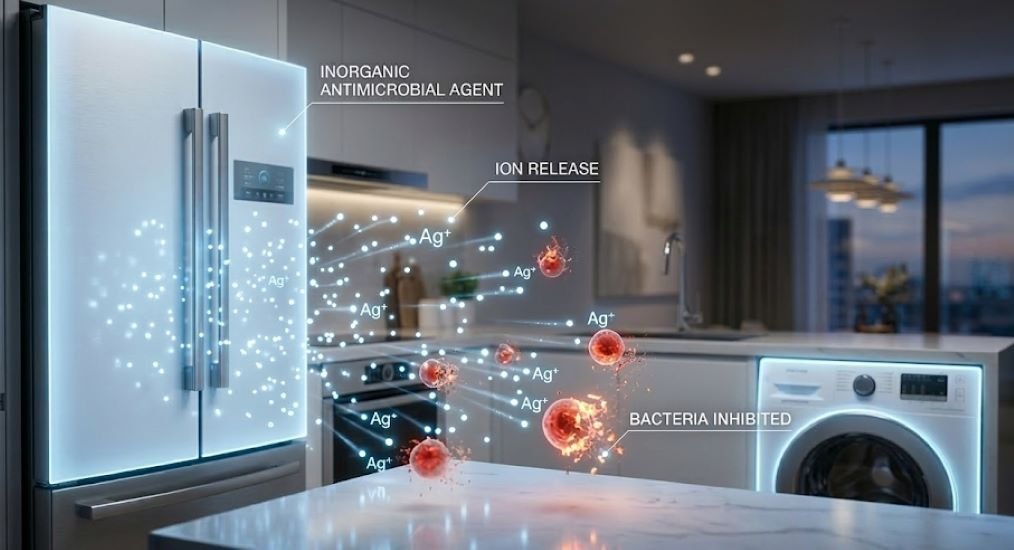
We talk a lot about smart homes. Voice control. Energy saving. Automated lighting. But almost no one talks about bacteria. Right now, bacteria are growing on the surfaces inside your appliances. And your smart home is doing nothing about it. I work with functional materials every day at Langyi. I keep seeing the same gap. Our homes are getting smarter. But they are not getting safer. Keep reading. Because the answer is closer than you think. And it starts somewhere most people never look — inside the material itself.
The Kitchen, the Fridge, the Washing Machine — Are These Your Home's Biggest Bacteria Hotspots?
You clean your kitchen. You think it is safe. But bacteria grow back within hours. The places you trust most may be the riskiest spots in your home.
The kitchen, fridge, and washing machine are three of the most bacteria-heavy spots in any home. They stay warm and wet. Bacteria grow fast in those conditions. Standard cleaning removes bacteria for a short time. But without antimicrobial protection built into the surface, the bacteria always come back.
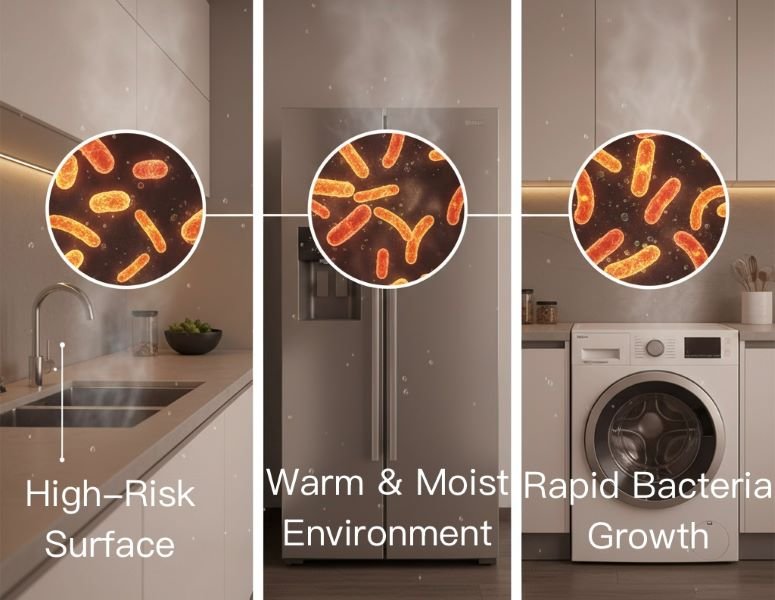
I remember talking to an appliance engineer at a trade show. His team had tested their washing machine drum after a full cleaning cycle. The bacteria count dropped right after the clean. But within 24 hours, it was back to the same level. That result stayed with me for a long time.
The problem is not that people clean poorly. The problem is that cleaning is temporary.
Why Standard Surfaces Fail
Surfaces are passive. They do nothing between cleans. They collect bacteria. They hold moisture. They give bacteria everything they need to grow. Every hour between cleaning sessions is an hour bacteria have to multiply unchecked.
Here is how bacteria build up across three key appliances:
| Appliance | Main Bacteria Source | Why It Is a Problem |
|---|---|---|
| Refrigerator | Food residue, moisture | Bacteria grow directly next to stored food |
| Washing Machine | Damp drum, detergent buildup | Mold and bacteria survive wash cycles |
| Kitchen Surfaces | Raw food, hands, utensils | High-contact area, recontaminated very fast |
What the Numbers Show
Studies show that a kitchen sponge can carry more bacteria per square centimeter than a toilet seat. The fridge handle is touched dozens of times a day. The washing machine drum stays damp for hours after each cycle. These are not edge cases. They are normal conditions inside a home.
The solution is not more cleaning products. The solution is a surface that fights back between cleans. That means putting antimicrobial function directly into the material. Not onto it. Into it. This is what inorganic antimicrobial agents do. They become part of the surface. They do not wash off. They do not break down quickly. They keep working long after the cleaning is done. Health is the new smart.
Your Surfaces Touch Everything — So Why Aren't They Fighting Back?
Think about how many times you touch your fridge handle today. Then think about everyone else who does too. Surfaces move bacteria from hand to hand all day long.
Surfaces without antimicrobial properties are passive. They collect bacteria and spread them. Inorganic antimicrobial surfaces are different. They release metal ions that damage bacterial cell walls. This stops bacteria from multiplying. The surface becomes active, not passive.
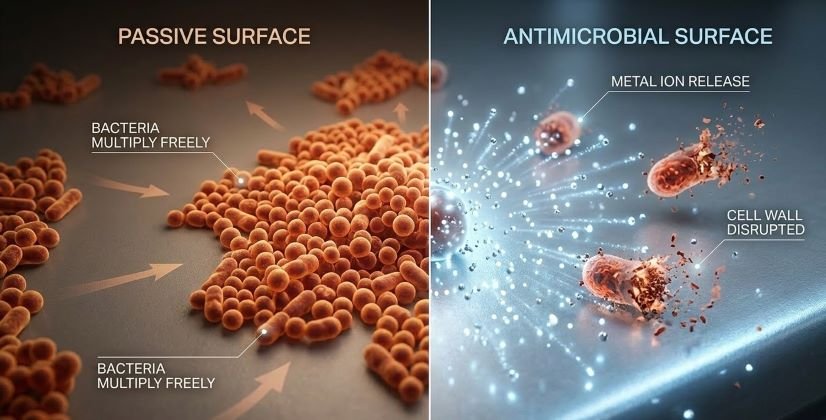
This shift — from passive to active — is the one I care most about.
Most people think of hygiene as a behavior. You wash your hands. You clean the counter. But hygiene can also be a material property. It can be built into a product from the very start.
Active vs. Passive: A Direct Comparison
Here is how antimicrobial surfaces compare to standard ones:
| Property | Standard Surface | Antimicrobial Surface |
|---|---|---|
| Bacteria growth | Grows freely | Stopped by ion release |
| When it works | Only right after cleaning | All the time |
| Protection lifespan | Minutes to hours | Years |
| Needs user action | Yes | No |
How the Technology Actually Works
Inorganic antimicrobial agents work through a simple process. Metal ions — most often silver, zinc, or copper — are mixed into the material during production. When bacteria land on the surface, the ions break down the bacteria's cell function. The bacteria cannot grow. The bacterial count on that surface stays low over time.
This is very different from a surface coating. Coatings sit on top of the material. They wear away with use, heat, and time. They chip. They need to be reapplied. Inorganic agents are not applied after production. They are added during production. They are not on the surface. They are part of it. This makes them far more durable and far more reliable over the full life of a product. For manufacturers, this is not just a new product feature. It is a change in what the product fundamentally does for the person using it.
Stop Cleaning, Start Protecting — Can Self-Sanitizing Technology Change the Way We Live?
You clean the same surfaces every week. They get dirty again. You clean them again. What if the surface could do part of that work for you?
Self-sanitizing surfaces reduce bacterial growth all the time. They do not replace cleaning. But they cut down how often deep cleaning is needed. And they lower the risk of bacteria spreading between cleaning sessions. This changes how a home works every single day.
I think about this in simple terms. A surface is either passive or active. Passive surfaces collect what lands on them. Active surfaces respond to what lands on them. Antimicrobial surfaces are active. And active surfaces change how people live at home.
What "Self-Sanitizing" Actually Means
The phrase "self-sanitizing" can sound like marketing language. I understand that. So I want to be very clear about what it means — and what it does not mean.
Antimicrobial surfaces do not sterilize. They inhibit. They slow bacterial growth. They reduce the bacterial load on a surface. They do not make cleaning unnecessary. But they make every hour between cleans safer than it would be on a standard surface.
Here is what that looks like in real use:
| Situation | Without Antimicrobial Surface | With Antimicrobial Surface |
|---|---|---|
| Between cleaning sessions | Bacteria multiply freely | Bacterial growth stays low |
| High-touch areas (handles, buttons) | Recontaminated quickly | Ion activity reduces bacterial load |
| After illness in the home | High risk of surface spread | Lower risk of recontamination |
| Long periods without use | Bacteria build up fast | Surface stays more hygienic |
Who This Matters For Most
For most homes, this difference is meaningful. But for homes with children, elderly people, or anyone with a weaker immune system, it matters much more. These groups face a higher risk from bacteria on everyday surfaces. They benefit the most from a surface that does not just wait to be cleaned.
At Langyi, I have watched this play out with our customers over and over. When manufacturers add antimicrobial function to their materials, the product they bring to market is different. Not just cleaner-looking. Actively protective. It works for the user in a way a standard product simply cannot.
Powered by Inorganic Antimicrobial Technology — What Makes It Built to Last and Built to Protect?
You have seen the word "antimicrobial" on sprays and packaging. But built-in antimicrobial technology is different. What makes inorganic agents the right choice for long-lasting products?
Inorganic antimicrobial agents last longer than organic ones. They are not easy to decompose at high temperature. They stay stable through the manufacturing process. And they keep working for the full life of the product. This makes them the right material choice for appliances, surfaces, and any product that needs long-term protection.
I want to explain clearly why inorganic is the better choice here. There are two main types of antimicrobial agents used in materials: organic and inorganic. Organic agents come from carbon-based compounds. They can work well in the short term. But they break down. Heat, UV exposure, and time all reduce how well they perform. For a product that needs to last 5 to 10 years, this is a real and serious problem.
Organic vs. Inorganic: A Side-by-Side Look
| Feature | Organic Antimicrobial Agent | Inorganic Antimicrobial Agent |
|---|---|---|
| Heat stability | Low to medium | High |
| Useful product lifespan | 1–3 years | 5–10+ years |
| Works with manufacturing | Limited processes | Works with most processes |
| Safety record | Varies by compound | Well-documented |
| Active ingredient | Carbon-based compound | Metal ion (Ag, Zn, Cu) |
How Langyi Puts This Into Practice
At Langyi, our inorganic antimicrobial additives are designed to be mixed into plastics, ceramics, coatings, and fibers during production. They do not change how a product looks. They do not change how it feels. But they change what the surface does every day for the rest of that product's life.
Langyi was founded by Dr. Tang, a material scientist who graduated from Tsinghua University. For us, that job is protection. We work directly with manufacturers to find the right additive for their specific material and process. We do not just sell a product. We help our customers build real protection into everything they make. This is what we mean at Langyi when we say: built to last, built to protect.
Health is the new smart. The next appliance will not just be connected — it will be protective. That protection starts at the material level, with inorganic antimicrobial technology.