
-300x210.jpg)
Is Your Child's Favorite Toy Fighting Back Against Bacteria?
Every day, your child grabs their toys, pencils, and erasers — then puts their hands near their mouth. Bacteria are already there. Most parents don't see it coming.
The safest toy is one built with antimicrobial protection inside the material itself. Inorganic antimicrobial agents are added directly into plastic during production. They suppress bacteria continuously — without sprays, coatings, or re-application. For children's toys and stationery, this is the most reliable form of protection available today.
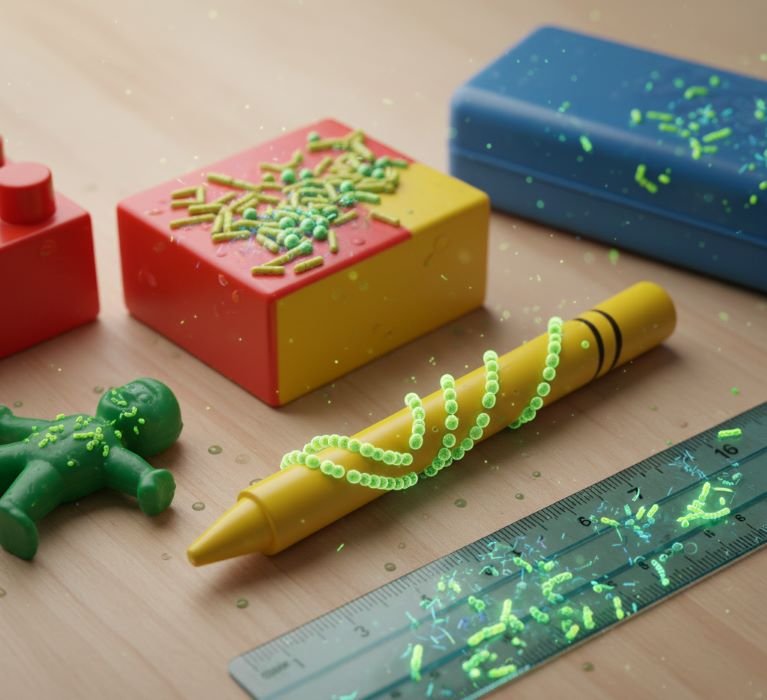
Most people assume clean-looking toys are safe toys. I used to think that too. Then I started looking at what actually lives on plastic surfaces — and I changed my mind completely. What I found made me rethink everything about how children's products are made. Keep reading, because the next section may change how you look at the products your child uses every single day.
The Threat You Can't See — But Your Child Touches Every Day?
Plastic toys look clean after a quick wipe. But bacteria can survive on plastic for up to 24 hours. Your child touches them hundreds of times a day.
Bacteria — including Staphylococcus aureus and E. coli — can survive on hard plastic surfaces for hours. Children touch these surfaces repeatedly and often touch their faces. This makes toys and stationery a direct transfer point for harmful microbes. The threat is real, invisible, and present every single day.
Why plastic surfaces are a problem
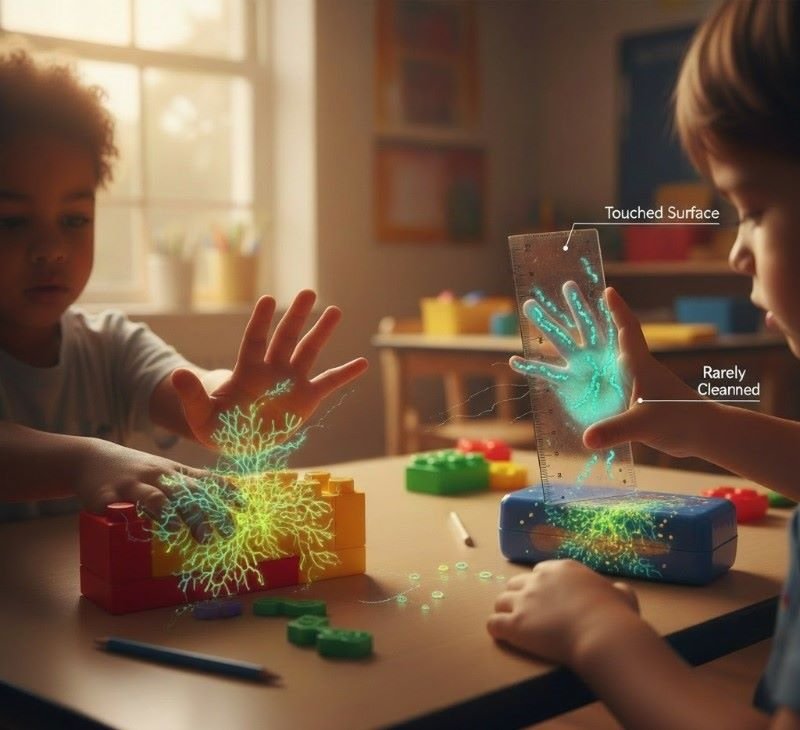
Plastic is everywhere in children's lives. Toys, rulers, pencil cases, building blocks — they all share one thing. They are touched constantly and cleaned rarely.
I visited a kindergarten classroom once. The teacher told me the children share crayons, erasers, and scissors every single day. Those items get wiped down maybe once a week. I remember thinking: that is not nearly enough.
Here is what the research tells us about how long bacteria survive on hard surfaces:
| Bacteria | Survival Time on Hard Surfaces | Common Transfer Source |
|---|---|---|
| Staphylococcus aureus | Up to 7 days | Skin contact |
| E. coli | Up to 3 days | Hands, fecal matter |
| Salmonella | Up to 4 days | Hand and food contact |
| Streptococcus | Up to 6 months | Respiratory droplets |
Why children are more exposed than adults
Children touch their faces roughly 300 times per day on average. Their immune systems are still developing. This means a surface that causes no harm to an adult can make a child sick.
The real problem is not that parents are careless. The problem is that the materials themselves are not designed to fight back. A toy that looks clean is not the same as a toy that is safe. Until the material itself becomes part of the protection, we are only solving half the problem.
Why Washing and Wiping Only Go So Far?
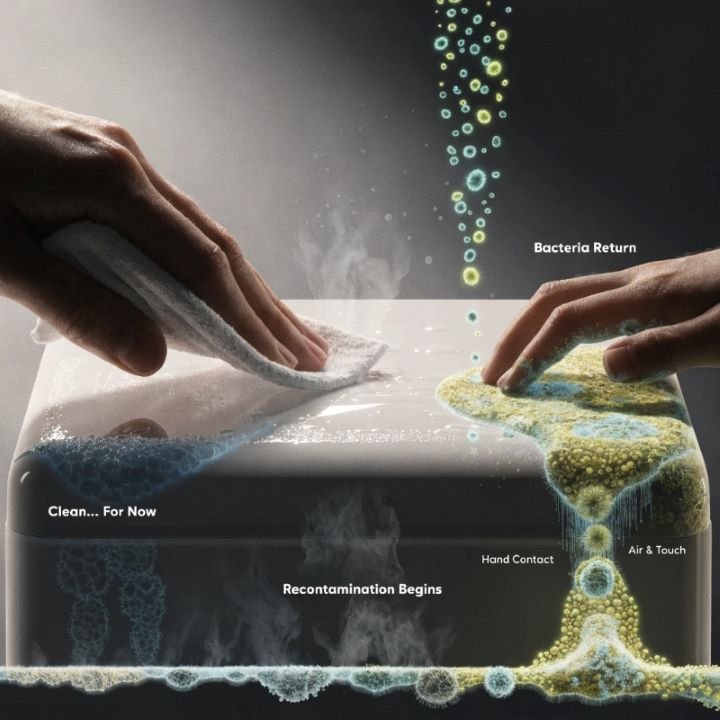
You wipe the toy down. You wash their hands. But bacteria come back within minutes. Cleaning removes bacteria — it does not stop them from returning.
Washing and wiping remove bacteria temporarily. They cannot prevent recontamination. Once the surface dries, bacteria grow back from hands, air, and contact. This cycle repeats all day. For lasting protection, the surface itself needs to resist bacteria — not just be clean for a moment.
Cleaning and protection are not the same thing
There is a real difference between making something clean and making it safe. Cleaning is a short-term action. Protection is a built-in property.
I think about it this way. You can mop a floor every hour. Or you can install a surface that resists dirt from the start. One takes constant effort. The other works on its own. The same logic applies to children's plastic products.
| Method | Duration of Effect | Requires Repeated Action | Effective Against Recontamination |
|---|---|---|---|
| Wiping with cloth | Minutes | Yes | No |
| Disinfectant spray | Hours | Yes | No |
| Antimicrobial surface coating | Months | No (applied once) | Partial |
| Built-in antimicrobial additive | Product lifetime | No | Yes |
The problem with coatings
Some manufacturers add an antimicrobial coating to the surface of their plastic products. On paper, this sounds like a reasonable solution.
But coatings wear off. They scratch. They wash away. A child who chews on a coated toy is not protected the same way in week three as they were on day one. Every scrape, every wash, every bite takes something away.
The only way to make lasting protection work is to put it inside the material — not on top of it. This is the shift that changes everything for children's products.
The Science Behind Materials That Defend Themselves?
What if the plastic itself could suppress bacteria on contact? This is not a future idea. It is what inorganic antimicrobial agents already do inside plastic products today.
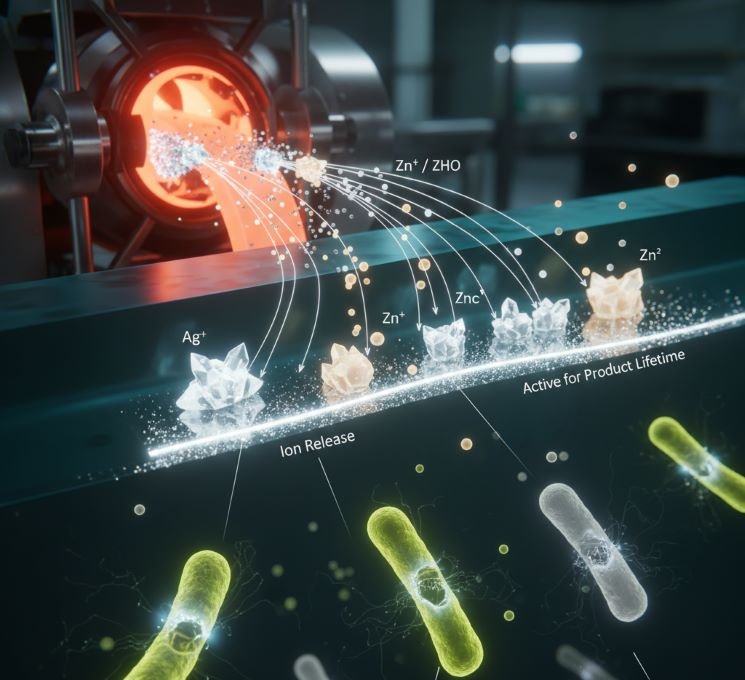
Inorganic antimicrobial agents — such as silver-based or zinc-based compounds — are blended into plastic during the manufacturing process. They release ions that disrupt bacterial cell function and prevent growth. Because they are part of the material itself, they remain active for the entire life of the product.
How inorganic antimicrobial agents work
The core mechanism is ion release. Inorganic antimicrobial agents — most commonly based on silver (Ag), zinc (Zn), or zinc oxide (ZnO) — slowly release metal ions at the material surface. These ions interfere with bacterial cell membranes. They stop bacteria from reproducing. The effect is continuous, and it does not require any action from the user.
This is not a chemical smell or a visible treatment. It is a material-level change that works silently, every hour, every day.
Why inorganic, not organic?
There are two main types of antimicrobial additives used in plastics: organic and inorganic. For children's products specifically, the difference matters a great deal.
| Property | Organic Antimicrobials | Inorganic Antimicrobials |
|---|---|---|
| Heat resistance | Low — may degrade during high-temp processing | High — stable at processing temperatures |
| Durability | Short-term | Long-term, product lifetime |
| Safety profile | Some concerns at higher concentrations | Well-documented, low toxicity |
| Suitable for children's products | Limited | Yes |
| Common active materials | Triclosan, DCOIT | Silver, Zinc, ZnO |
At Langyi, our inorganic antimicrobial agents are engineered to stay stable through injection molding and extrusion at temperatures above 200°C. The protection survives the manufacturing process intact — and stays active in the final product from the first day of use to the last.
This is the solution that cleaning and coating alone can never provide. It is built in. It does not wear off. It does not need to be reapplied.
Built-In, Long-Lasting, and Safe for the Smallest Hands?
Parents worry. Regulators are getting stricter. And children are more vulnerable than adults. Any antimicrobial solution for children's products must clear a very high bar for safety.
Inorganic antimicrobial additives used in children's products must meet strict safety requirements — including low migration rates, non-toxicity, and stability under real-use conditions. Silver-based and zinc-based additives, used in compliance with international standards, are considered safe for children's toys and stationery when properly formulated and tested.
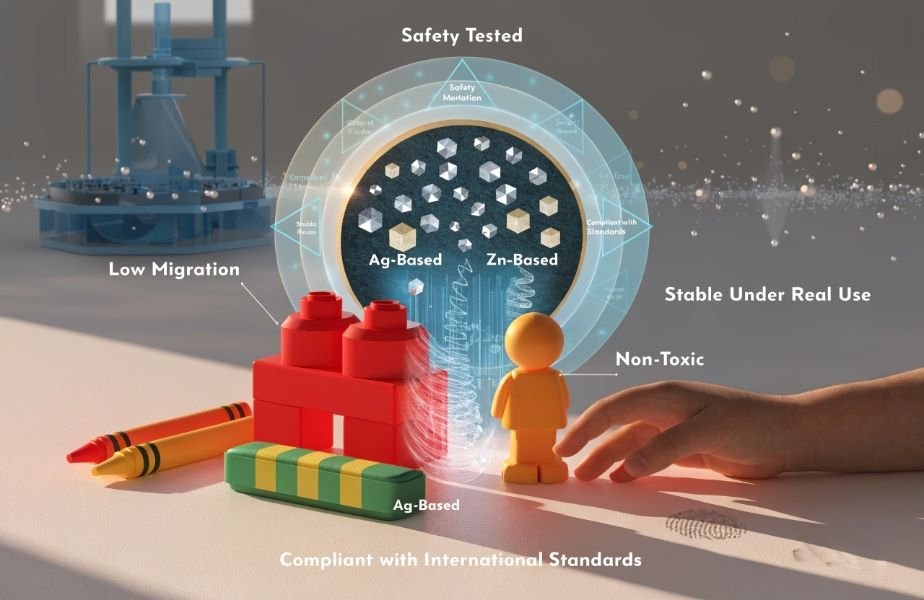
Safety is not optional — it is the starting point
When I say "safe for the smallest hands," I mean this in two ways. Safe for the child using the product every day. And safe through the full manufacturing and product use cycle.
At Langyi, our antimicrobial agents go through rigorous testing before they reach any manufacturer. The goal is always the same — confirm the antimicrobial effect works, and confirm that nothing harmful reaches the child.
What to look for in a compliant antimicrobial additive
Not all antimicrobial additives are equal. If you are a manufacturer evaluating options, here are the key criteria to use:
| Requirement | What It Means in Practice |
|---|---|
| Low migration rate | The additive stays inside the material, not on the child's skin |
| Non-toxic base material | No harmful heavy metals or reactive byproducts |
| Thermal stability | Survives plastic processing at 200°C and above |
| Broad-spectrum activity | Effective against both gram-positive and gram-negative bacteria |
The new standard for children's products
The next generation of children's stationery and toys is not just colorful and durable. It is antimicrobial by design. I believe manufacturers who adopt this standard early will have a real competitive edge.
Retailers are beginning to ask for it. Parents are beginning to demand it. Regulators are beginning to require it.
The question is no longer whether antimicrobial protection belongs in children's products. The question is whether your products have it yet.
Conclusion
Bacteria on toys and stationery are a real, daily threat. Built-in antimicrobial materials are the only lasting answer. The safest product is one that fights back — always.
Langyi — China's leading functional additives manufacturer www.antimicrobialadditive.com