
-300x210.jpg)
Cold Doesn't Mean Clean — Can Refrigeration Really Keep Your Food Supply Chain Safe?
You trust the cold chain to protect your food. But what if that trust is misplaced? Contamination events happen every year — inside perfectly refrigerated supply chains.
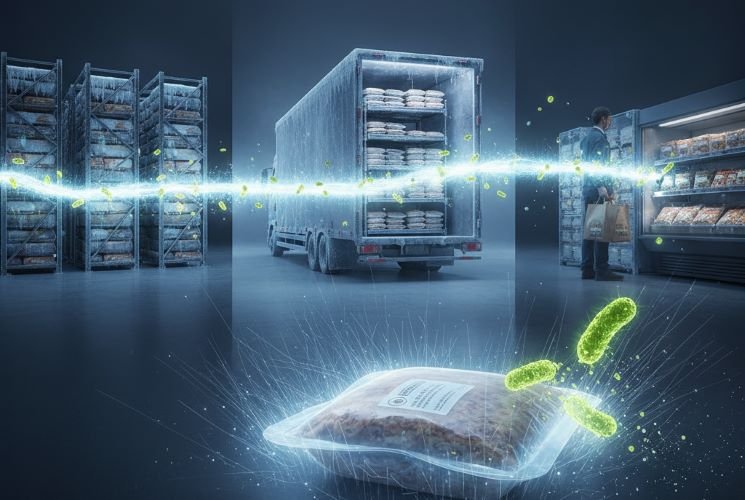
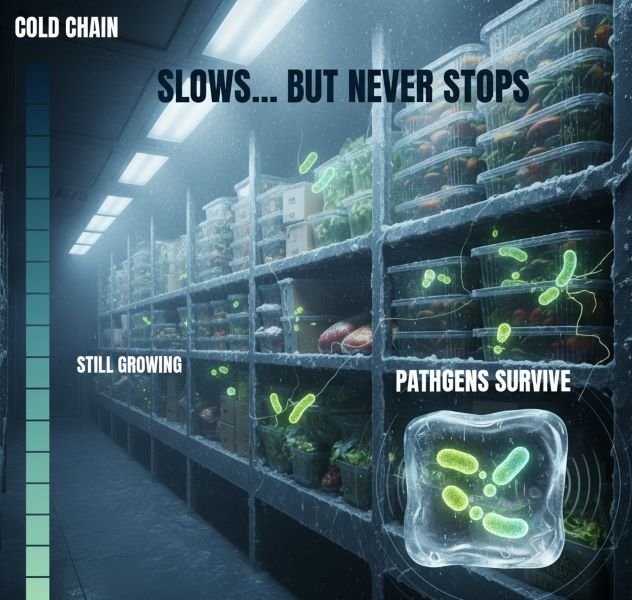
Refrigeration slows bacterial growth but does not stop it. Some pathogens survive and multiply at cold temperatures. Antimicrobial protection fills the gap that refrigeration leaves open. It targets harmful microbes directly, at every point in the logistics chain.
I have spoken with many food logistics professionals. Most of them believe that if the temperature is right, the food is safe. I used to think the same thing. Then I looked at the data. The picture was very different from what I expected. The gap between "cold" and "safe" is real — and it is where contamination quietly takes hold.
The Cold Chain Illusion: Why Can't Refrigeration Alone Guarantee Food Safety?
You set the thermostat. You monitor the temperature. You follow every protocol. Still, something goes wrong. Why does contamination happen inside a controlled cold chain?
Refrigeration is a tool for slowing down microbial activity. It is not a kill step. Bacteria like Listeria monocytogenes do not stop at 4°C — they adapt. Cold storage gives a false sense of security to many operators in the food industry.
The Gap Between "Cold" and "Safe"
I want to break this down clearly. There are two separate things happening inside a cold chain.
The first is temperature control. This slows down most bacteria. It buys time. The second is microbial safety. This means the actual suppression or elimination of pathogens. Temperature alone does not do this.
Here is a simple way to see the difference:
| Factor | What Refrigeration Does | What Antimicrobial Protection Does |
|---|---|---|
| Bacterial growth | Slows down most species | Actively suppresses or eliminates pathogens |
| Listeria monocytogenes | Still grows at 0–4°C | Inhibited by antimicrobial agents |
| Biofilm formation | Not prevented | Reduced by antimicrobial surface treatment |
| Cross-contamination | Not addressed | Reduced through antimicrobial material surfaces |
| Temperature fluctuation | Protection breaks down | Antimicrobial activity continues |
The gap in this table is the exact place where contamination events happen. A power outage. A door left open. A temperature spike during transport. These moments break the cold chain. When that happens, refrigeration offers zero protection. Antimicrobial materials keep working.
I have seen this pattern in incident reports again and again. The cold chain was intact. The temperature logs looked fine. But the contamination was already there — growing quietly on a surface, inside a package lining, on a storage bin that looked clean but was not.
This is the illusion. The thermometer shows a safe number. The microbes do not care about that number.
Hidden Threats: Which Pathogens Still Thrive — Even in the Cold?
Most people know that heat kills bacteria. Fewer people know that cold does not. Some pathogens are built for cold environments. They are the ones most likely to cause a problem inside your supply chain.
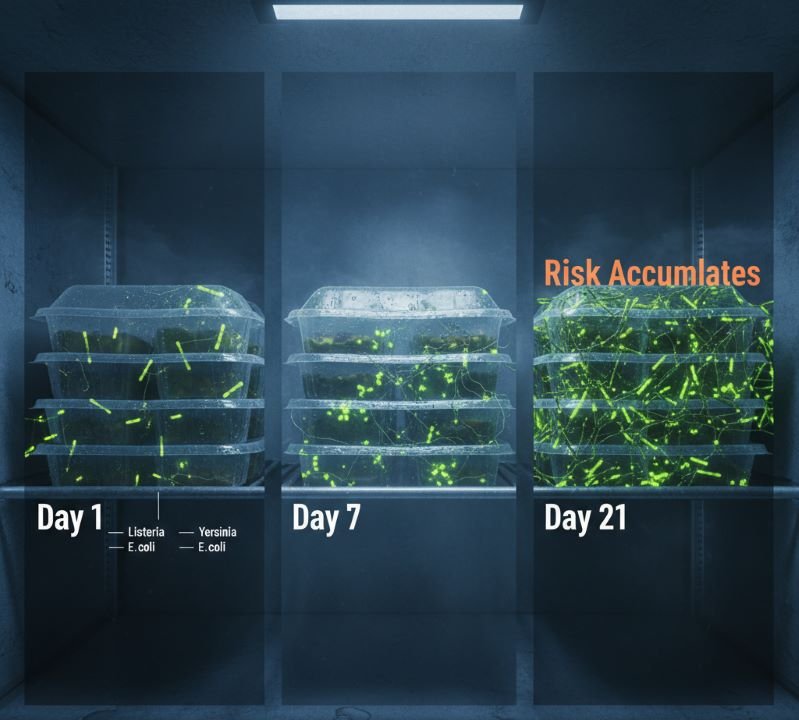
Listeria monocytogenes, Yersinia enterocolitica, and certain strains of E. coli grow slowly in the cold. But they grow. Over days and weeks in a distribution chain, slow growth adds up to a serious risk.
Why These Pathogens Are So Hard to Control
This is where most food safety programs have a blind spot. Cold-tolerant pathogens share a few key traits that make them very difficult to manage with temperature control alone.
First, they form biofilms. A biofilm is a thin layer of bacteria that sticks to a surface. It is hard to remove with standard cleaning. It resists many common disinfectants. It acts as a reservoir. Every time a new product touches that surface, it picks up a fresh dose of contamination.
Second, these pathogens are slow. This makes them hard to detect. A rapid test during inspection may show a negative result. Two days later, the count has crossed the safety threshold. The product is already at the retailer.
Third, cold chain environments are not perfectly uniform. Temperature fluctuates during loading and unloading. Different zones of a refrigerated truck sit at different temperatures. The surface of a package may be warmer than the core. These small differences give pathogens a window to grow faster than expected.
| Pathogen | Growth Temperature Range | Key Risk in Cold Chain | Common Source |
|---|---|---|---|
| Listeria monocytogenes | -0.4°C to 45°C | Grows in refrigerated storage | Packaging surfaces, drains, equipment |
| Yersinia enterocolitica | 0°C to 42°C | Multiplies in chilled meat products | Raw pork, contaminated water |
| E. coli O157:H7 | 2°C to 45°C | Survives cold transport | Fresh produce, cross-contamination |
Standard cold chain management does not address these risks at the source. Cleaning schedules help. But they are not continuous. Antimicrobial materials are. They act on the surface all the time — between cleaning cycles, during transport, and during storage. This is the protection gap that most operations are currently missing.
Why Are Inorganic Antimicrobials Built for Cold-Chain Environments?
There are many types of antimicrobial agents on the market. Organic ones. Natural ones. Nano-based ones. So why do I focus on inorganic antimicrobials? Because the cold chain is a specific environment. It demands specific properties that most antimicrobial technologies cannot consistently deliver.
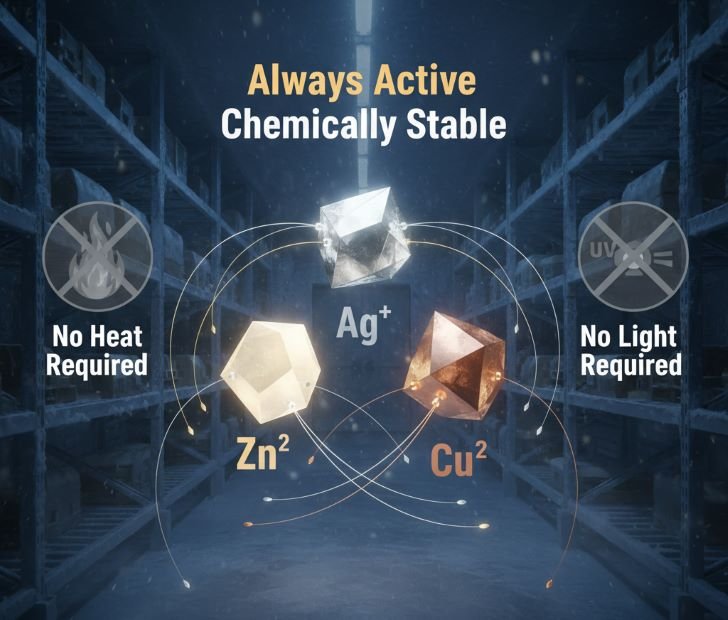
Inorganic antimicrobials — like zinc-based, silver-based, and copper-based compounds — are chemically stable. They do not degrade over time. They do not lose activity when the temperature drops. They work continuously without needing to be activated by heat or light.
What Makes Inorganic Antimicrobials Different
I have spent years working with functional material additives and looking at how different antimicrobial technologies perform in real-world conditions. The cold chain is one of the most demanding environments for any additive. Here is what I have observed.
Organic antimicrobials break down. Heat, UV exposure, humidity — all of these reduce their activity over time. In a cold chain, you might think heat is not an issue. But loading docks, warehouse lighting, and repeated transport transitions all expose materials to conditions that degrade organic agents faster than expected.
Inorganic antimicrobials do not have this problem. Their mechanism of action is based on controlled ion release. This release is slow, steady, and continuous. It does not depend on temperature. It does not depend on the environment being kept at a perfect condition. This is exactly what a cold chain operation needs.
| Property | Organic Antimicrobials | Inorganic Antimicrobials |
|---|---|---|
| Thermal stability | Degrades above certain temperatures | Stable across a wide temperature range |
| Long-term activity | Decreases over product lifetime | Sustained ion-release mechanism |
| Leaching risk | Higher, less controlled | Lower, more controlled release |
| Regulatory acceptance | Varies by region | Widely accepted — FDA, EU, GB standards |
| Polymer compatibility | Limited in some formulations | Broad compatibility with common food-contact polymers |
| Effectiveness against biofilms | Moderate | High, especially silver-based compounds |
The sustained release mechanism is the most important point here. It means the surface stays protected even when it has not been cleaned recently. In a busy logistics operation, that matters. You cannot clean every surface every hour. The material does the work in between.
At Langyi, our team — led by Dr. Tang, a materials scientist from Tsinghua University — has spent years formulating inorganic antimicrobial additives that match the real demands of industrial supply chains. Cold chain logistics is one of the most critical application areas we serve, and the chemistry behind our solutions is built specifically for that environment.
From Packaging to Storage: How Can Inorganic Antibacterial Agents Guard Every Link in the Chain?
The cold chain is not one thing. It is a series of connected steps. Each step involves different materials, different surfaces, and different risks. A good antimicrobial strategy must cover all of them — not just the most visible one.
Most companies focus on one point. They add antimicrobial treatment to packaging and stop there. They overlook the storage bins, the conveyor belts, and the inner linings of refrigerated containers. Each of these is a potential contamination point that gets ignored.
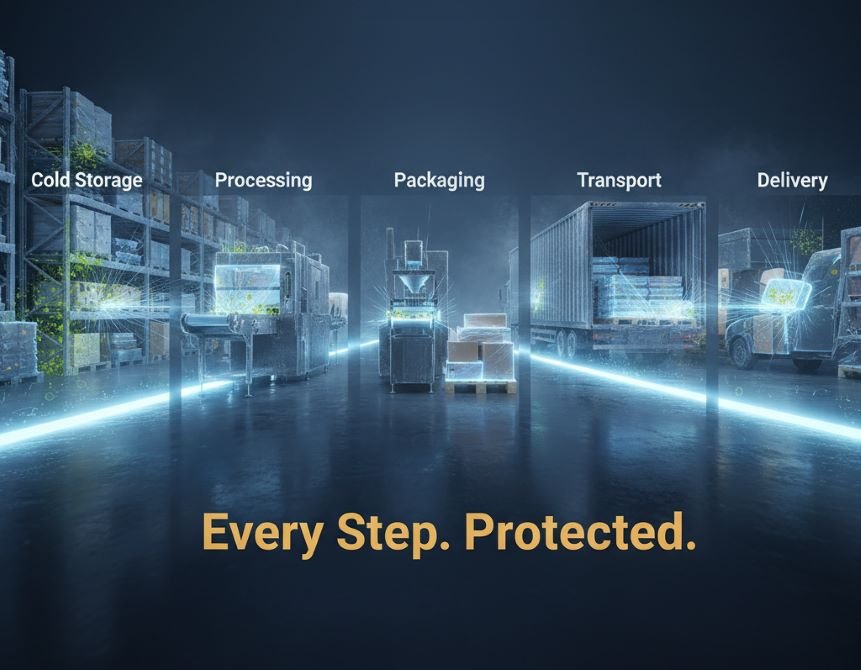
Mapping Antimicrobial Protection Across the Cold Chain
I want to walk through the cold chain step by step. At each step, I will show where inorganic antimicrobial agents can be applied and what specific risk they address. These are real applications that material manufacturers and logistics operators can act on today.
The core idea is continuity. Antimicrobial protection only works when it is present at every link. A chain is only as strong as its weakest point. If packaging is protected but the storage bin is not, contamination enters at the bin. If transport liners are treated but loading area equipment is not, the product is exposed during the most high-risk handling phase.
| Cold Chain Step | Key Materials | Antimicrobial Application | Risk Addressed |
|---|---|---|---|
| Primary packaging | Films, wraps, trays | Additive built into polymer during manufacturing | Direct contact surface contamination |
| Secondary packaging | Cartons, corrugated boxes | Antimicrobial coating or incorporated additive | Pathogen transfer between packages |
| Cold storage | Shelving, bins, containers | Antimicrobial plastic compound or surface coating | Biofilm formation and cross-contamination |
| Refrigerated transport | Container linings, pallets | Antimicrobial material in construction or lining | Contamination during transit |
| Loading and unloading areas | Conveyor belts, equipment surfaces | Antimicrobial surface treatment | High-touch point contamination |
| Retail display | Display trays, stretch films | Antimicrobial additive incorporated into film | Last-mile contamination exposure |
Inorganic antimicrobial additives can be built into most of these materials during the manufacturing process. They do not require a separate step. They become part of the material itself. This means the protection is permanent — it does not wash off, it does not wear off, and it does not need to be reapplied.
At Langyi, we work with manufacturers at the material level. We help them build antimicrobial protection into their products before those products ever enter the cold chain. Our additives are compatible with common food-contact polymers and meet international food safety standards across multiple markets.
The future of food logistics isn't just about keeping things cold — it's about keeping things safe at every degree.
Conclusion
Cold is not enough. Refrigeration buys time, but it does not buy safety. Inorganic antimicrobial protection works at every link and at every degree — closing the gap that temperature control alone can never fill.
Langyi — China's Leading Functional Additives Manufacturer www.antimicrobialadditive.com