
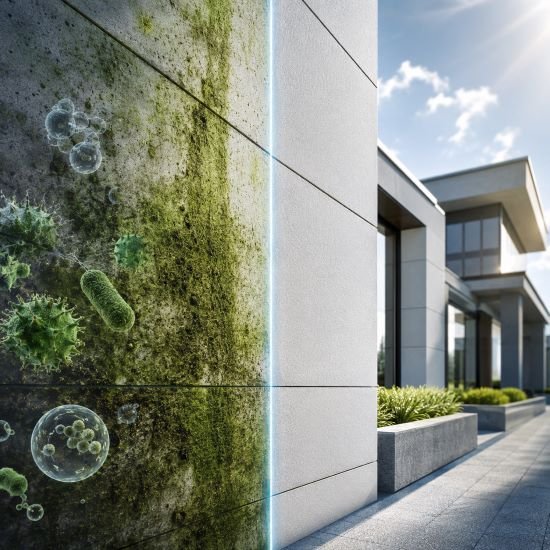
Outdoor material protection should go beyond fighting bacteria—it should address the broader microbial challenges of algae, mold, and moisture from the material itself.
Green algae, black mold and microbial staining are common concerns for exterior building materials exposed to moisture, humidity and changing weather conditions. Repeated cleaning may improve appearance temporarily, but material-integrated antimicrobial technologies offer a more proactive approach to microbial growth control.
Antimicrobial additives are functional ingredients incorporated into materials during manufacturing. Depending on the active technology and application, they can help inhibit the growth of bacteria, fungi and other microorganisms on or around the treated material, supporting cleaner surfaces and longer-lasting product performance.
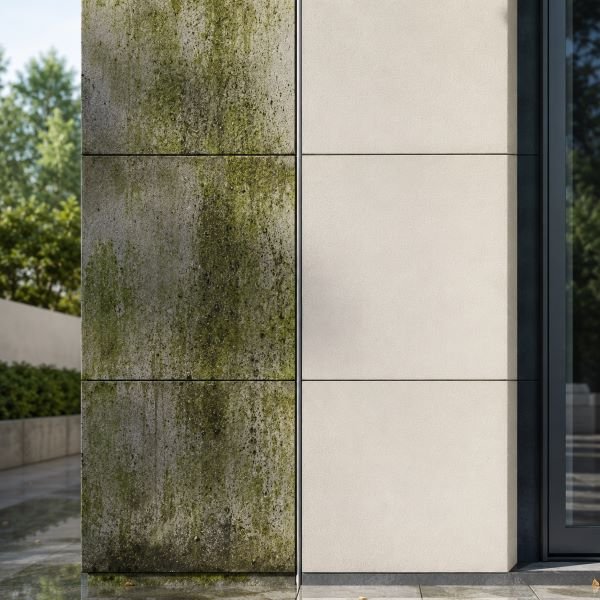
Outdoor walls, roofs, cladding, coatings and other building components are continuously exposed to rain, humidity, sunlight, dust and temperature changes. Understanding how these conditions support microbial growth is the first step toward selecting a suitable material-based solution.
Why Do Algae, Mold and Microbes Grow on Outdoor Building Materials?
Outdoor building surfaces can create favorable conditions for microbial colonization when moisture, nutrients and a suitable surface environment occur together.
Rainwater, condensation and high humidity provide moisture. Dust, pollen and airborne organic matter can accumulate on surfaces and provide nutrients. Surface roughness and porosity can also create locations where microorganisms attach and remain protected from environmental disturbance.
For algae in particular, light availability is another important factor. This helps explain why green staining is often visible on exterior walls, roofs and other surfaces that remain damp while receiving sufficient light.
The Microbial Growth Triangle
Three conditions are particularly important:
- Moisture – Rain, condensation, high humidity and poor drainage can keep surfaces damp for extended periods.
- Nutrients – Dust, pollen, pollutants and other organic deposits can provide nutrients for microbial growth.
- Suitable Surface Conditions – Porous, rough or weathered materials can provide sites for microbial attachment and colonization.
The material itself can influence how long these conditions persist. Concrete and stucco, for example, can retain moisture because of their porous structure, while wood can absorb water and provide an organic substrate. Exterior paints and polymer-based materials may also accumulate surface deposits over time.
| Outdoor Material | Typical Vulnerability | Common Microbial Concerns |
|---|---|---|
| Exterior paints & coatings | Surface moisture, organic binders and deposited contaminants | Mold, algae |
| Concrete & stucco | Porosity and moisture retention | Algae, mold |
| Wood siding | Water absorption and organic composition | Mold, fungi |
| PVC & polymer cladding | Surface deposits, moisture and weathering | Algae, mold |
This is why microbial protection cannot always be addressed effectively through surface cleaning alone. The material system, environmental exposure and antimicrobial technology all need to be considered together.
How Can Antimicrobial Additives Help Protect Exterior Building Materials?
Traditional approaches such as pressure washing, cleaning agents and surface treatments can remove existing contamination, but microbial growth may return when favorable environmental conditions remain.
Antimicrobial additives provide another approach: incorporating microbial-growth-control functionality into the material itself during manufacturing.
Depending on the active ingredient, carrier system and material formulation, antimicrobial additives can interfere with microbial growth through mechanisms such as disruption of cellular functions or inhibition of microbial metabolism and reproduction.
The effectiveness of the final product depends on much more than the antimicrobial ingredient alone. Factors such as additive dispersion, active-agent availability, material compatibility, processing conditions and environmental exposure can significantly influence performance.
Material-Integrated Protection vs. Surface Treatment
A key advantage of material-integrated antimicrobial technology is that the functionality is incorporated into the product during manufacturing rather than relying solely on a temporary surface application.
For polymer products, antimicrobial additives can be incorporated during compounding or masterbatch processing. For coatings and paints, the additive can be dispersed into the formulation before application.
This approach can provide more consistent antimicrobial functionality while reducing reliance on repeated surface treatment.
However, “built-in” does not automatically mean permanent. Outdoor durability still depends on the formulation, additive chemistry, concentration, exposure conditions and characteristics of the finished material. Appropriate laboratory and application testing remains essential.
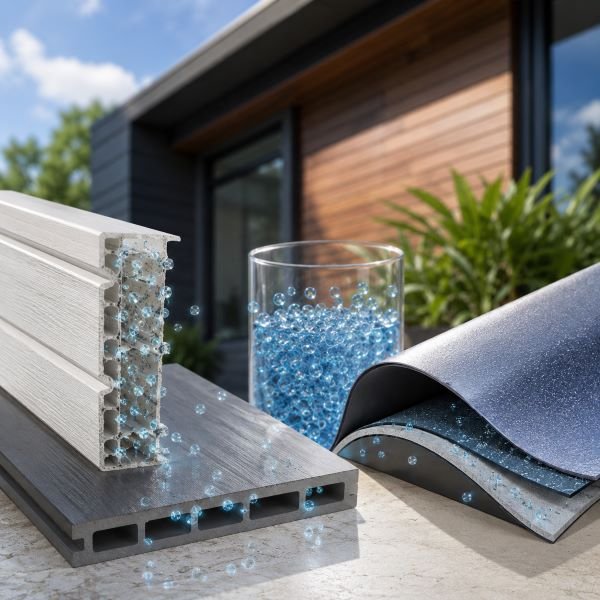
What Types of Antimicrobial Additives Can Be Used in Outdoor Material Applications?
Different antimicrobial technologies can be considered depending on the material and target microorganisms.
Inorganic technologies based on silver, zinc and copper ions are widely used in antimicrobial material applications. These technologies can offer different balances of antimicrobial performance, thermal stability, compatibility, appearance and cost.
For outdoor building materials, the choice should not be based simply on which active ingredient appears stronger in a laboratory test. The complete material system needs to be evaluated.
Silver-Based Antimicrobial Technology
Silver-based technologies are widely used where strong antimicrobial performance, broad application potential and material compatibility are important considerations.
Shanghai Langyi provides silver-ion antimicrobial additives and antimicrobial masterbatches designed for different polymer and functional-material applications.
The AntibacMax Silver Antimicrobial Masterbatch is available in different carrier systems and can be customized for polymers including PP, PET, PA, ABS, PE and TPU. Its reported properties include antimicrobial and anti-mold performance, thermal stability and good dispersion in polymer materials.
For outdoor plastic components, films, cladding-related polymer products and other applications where material-integrated antimicrobial functionality is required, silver-based technology can be considered as one potential solution.
Zinc-Based Antimicrobial Technology
Zinc-based antimicrobial systems can provide another option when manufacturers need to balance antimicrobial performance, formulation compatibility and cost.
The suitability of a zinc-based additive depends on the specific zinc chemistry, carrier, concentration and host material. Therefore, testing within the actual polymer, coating or building-material formulation is recommended rather than evaluating zinc technology in isolation.
Copper-Based Antimicrobial Technology
Copper-based antimicrobial technologies are also used in selected polymer, coating, rubber and other functional-material applications.
Copper chemistry can provide useful antimicrobial performance, but formulation and appearance should be carefully evaluated. In applications where color, transparency or surface appearance is particularly important, compatibility testing becomes especially relevant.
For a broader comparison of silver, zinc and copper technologies, see:
How to Choose the Right Antimicrobial Additive for Outdoor Building Applications?
Selecting an antimicrobial additive for an outdoor building material requires more than identifying the target microorganism.
A suitable solution should match the material, manufacturing process, environmental exposure and performance target.
1. Identify the Main Microbial Challenge
The first question is what type of microbial growth needs to be controlled.
Is the primary concern:
- Green algae on exterior surfaces?
- Mold or fungal growth?
- Bacterial contamination?
- A combination of microorganisms?
Different antimicrobial technologies can have different activity profiles. The target organisms should therefore be defined before selecting the additive.
2. Match the Additive to the Material
The same antimicrobial technology may behave differently in different material systems.
For example, an additive intended for:
- PP or PE polymer products
- PVC cladding
- Exterior paints
- Architectural coatings
- Rubber components
- Sealants or other functional materials
may require different carrier systems, loading levels or processing conditions.
Compatibility should also be evaluated for color, transparency, mechanical properties, curing behavior and dispersion.
3. Consider Outdoor Exposure
Outdoor materials face more demanding conditions than many indoor products.
UV exposure, rainfall, humidity, temperature fluctuations, surface abrasion and pollution can all influence long-term performance.
This makes durability testing particularly important when developing antimicrobial outdoor products.
4. Consider Regulatory and Product-Claim Requirements
Antimicrobial products may be subject to different regulatory requirements depending on the country, application and type of claim being made.
Manufacturers should distinguish between protecting the material from microbial deterioration and making public-health or disinfectant claims. The appropriate regulatory framework should be reviewed before commercial launch.
5. Balance Performance, Compatibility, Durability and Cost
A technically effective additive may not necessarily be the right commercial solution if it creates processing problems or significantly increases material cost.
| Selection Factor | Key Question | Why It Matters |
|---|---|---|
| Target microorganisms | What organisms need to be controlled? | Determines the appropriate antimicrobial technology and testing approach |
| Material compatibility | Does the additive work with the polymer, coating or substrate? | Helps maintain appearance and physical properties |
| Processing stability | Can it withstand extrusion, molding, compounding or curing? | Prevents performance loss during manufacturing |
| Outdoor durability | How will UV, moisture and weathering affect performance? | Important for long-term exterior applications |
| Appearance | Could the additive affect color or transparency? | Critical for architectural and decorative products |
| Regulatory requirements | What requirements apply in the target market? | Helps support compliant product development |
| Cost | What loading level fits the product target? | Determines commercial feasibility |
How Can Shanghai Langyi Support Antimicrobial Material Development?
For manufacturers developing antimicrobial building materials, selecting a raw material is only one part of the process.
Shanghai Langyi Functional Materials focuses on antimicrobial additives and customized functional-material solutions for different substrates and manufacturing processes.
The company's AntibacMax antimicrobial technology covers silver-ion, zinc-ion and copper-ion solutions, together with customized antimicrobial masterbatches for polymers.
The AntibacMax antimicrobial additive range is designed for integration into materials such as plastics, coatings, textiles, films, fibers and other functional products.
For polymer manufacturers, customized masterbatch solutions are available for materials including PP, PE, ABS, PET and PVC, helping manufacturers introduce antimicrobial functionality through established polymer-processing routes.
The development process can be approached systematically:
Application → Material → Processing → Target Microorganisms → Additive Selection → Laboratory Testing → Product Validation
This approach is particularly useful for outdoor applications because the same antimicrobial additive may not be equally suitable for every building material or environmental condition.
From Material Challenge to Antimicrobial Solution
A building-material manufacturer developing an outdoor polymer product, for example, may need to consider:
- Whether algae, mold or bacteria is the primary concern
- The polymer and processing temperature
- Required additive concentration
- UV and weathering exposure
- Surface appearance and color requirements
- Expected service conditions
- Applicable regulatory requirements
- Overall cost target
Once these parameters are defined, suitable antimicrobial technologies can be shortlisted and tested within the actual formulation.
This material-specific approach is more reliable than selecting an additive based solely on its antimicrobial test result.
Conclusion: Outdoor Protection Starts at the Material Level
Algae, mold and microbial growth on outdoor building materials are rarely caused by a single factor. Moisture, environmental exposure, surface characteristics and material composition all contribute to the problem.
Cleaning and maintenance remain important, but antimicrobial additives provide manufacturers with another strategy: building microbial-growth-control functionality into the material during production.
Silver-, zinc- and copper-based technologies each offer different possibilities. The right choice depends on the target microorganisms, host material, manufacturing process, outdoor exposure, durability requirements, regulatory environment and cost.
For manufacturers developing antimicrobial plastics, coatings, cladding, films or other outdoor building materials, a material-specific evaluation can help identify a more appropriate antimicrobial solution.