
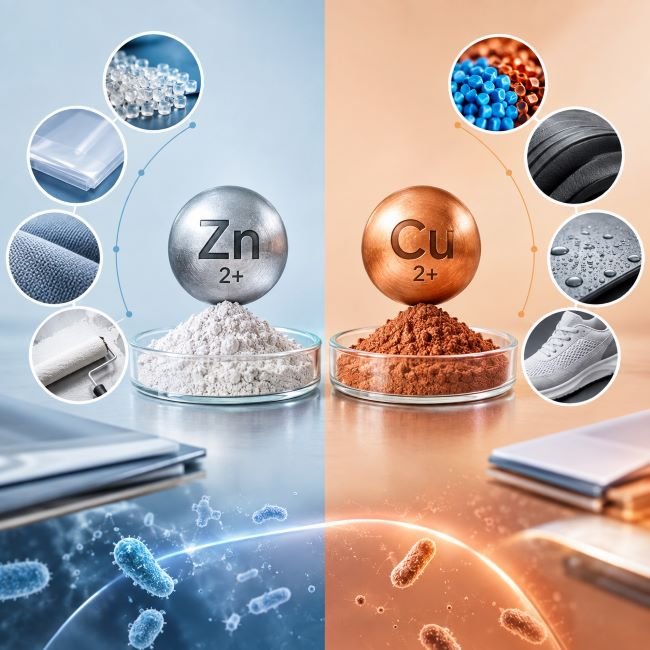
Choosing between zinc and copper antimicrobial additives is not simply a question of which metal ion has stronger antimicrobial activity. The better choice depends on the material, processing conditions, product requirements, and environment in which the finished product will be used.
For manufacturers developing antimicrobial plastics, coatings, textiles, films, rubber, or other functional materials, understanding these differences can help avoid compatibility problems, unnecessary costs, and performance compromises.
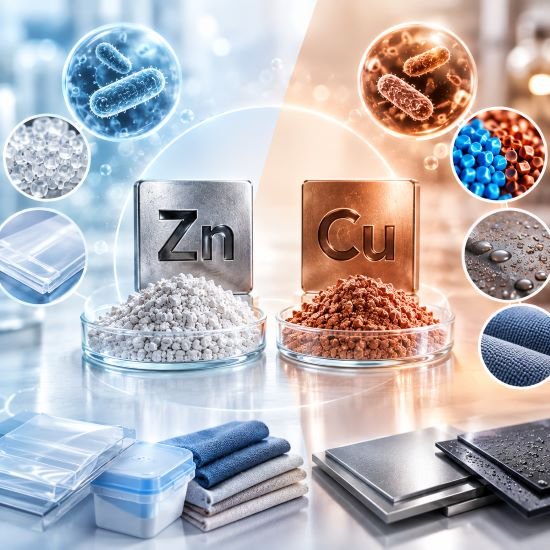
Why Do Zinc and Copper Antimicrobial Additives Work Differently?
Metal-ion antimicrobial technologies generally work by interacting with microbial cells and interfering with processes that are essential for microbial survival and growth.
However, zinc and copper do not behave identically.
Copper ions can interact strongly with microbial cell components and participate in oxidative processes, while zinc ions can interfere with enzymes and other cellular functions. Their antimicrobial behavior is influenced not only by the metal itself, but also by the chemical form, carrier, ion-release behavior, concentration, and surrounding material system.
This distinction matters because antimicrobial performance is only one part of the selection process. An additive must also remain compatible with the material and manufacturing process.
Copper: Strong Antimicrobial Activity with Formulation Considerations
Copper-based antimicrobial technologies are widely considered for applications where effective control of microbial growth is required.
Copper ions can interact with microbial membranes, proteins, and other cellular components. This broad interaction can support antimicrobial performance against different types of microorganisms.
However, copper-based formulations may require particular attention to color, dispersion, oxidation, and compatibility, especially in applications where appearance is critical.
For dark-colored, opaque, industrial, or functional products, these considerations may be easier to accommodate. For transparent or light-colored products, formulation development and testing become particularly important.
Zinc: A Practical Option When Material Compatibility Matters
Zinc-based antimicrobial technologies can be attractive when manufacturers need to balance antimicrobial functionality with material and appearance requirements.
Zinc compounds can be incorporated into different polymer, coating, and textile systems, depending on the specific formulation and application. Certain zinc-based technologies may also be considered where color, UV exposure, processing conditions, or cost-performance balance are important factors.
However, “zinc” should not be treated as a single technology. Different zinc chemistries can behave differently in terms of antimicrobial activity, dispersion, durability, and compatibility.
The practical question is therefore not simply:
“Is zinc better than copper?”
It is:
“Which zinc or copper technology is compatible with this specific material, process, and end-use environment?”
Zinc vs. Copper: Key Selection Factors
| Selection Factor | Zinc-Based Antimicrobial Additives | Copper-Based Antimicrobial Additives |
|---|---|---|
| Antimicrobial performance | Suitable for a wide range of applications when properly formulated | Suitable for a wide range of antimicrobial applications |
| Material compatibility | Depends on zinc chemistry, carrier, substrate, and loading | Depends on copper chemistry, carrier, substrate, and loading |
| Appearance | Can be suitable for applications with tighter color requirements, depending on formulation | Some formulations may influence color or appearance |
| Processing stability | Formulation and processing dependent | Formulation and processing dependent |
| Outdoor applications | Can be considered where environmental and UV exposure are important | Can be considered where stronger antimicrobial requirements are needed |
| Cost considerations | Can provide a useful cost-performance balance in selected applications | Can be attractive for selected industrial applications |
| Typical materials | Plastics, coatings, fibers, films and other materials | Plastics, coatings, fibers, films, rubber and other materials |
The table is a general selection guide. Actual performance depends on the specific antimicrobial chemistry, dosage, carrier, substrate, processing conditions, and test method.
Zinc vs. Copper: Which Antimicrobial Additive Fits Your Material and Application?
The right antimicrobial technology should be selected according to the complete material system, rather than the active metal ion alone.
For example, a transparent plastic component may prioritize appearance and optical properties, while an outdoor polymer may place greater emphasis on environmental durability. A textile may require wash durability, while a coating may depend heavily on binder compatibility and dispersion.
1. Clear Plastics, Films and Light-Colored Materials
For transparent or light-colored products, appearance can be a critical specification.
Any antimicrobial technology that changes color, transparency, haze, or surface appearance may create problems during production or final use.
Zinc-based systems can therefore be worth evaluating for applications where appearance and material compatibility are important. However, actual optical performance should always be confirmed in the finished formulation.
Potential applications include:
- Transparent plastic components
- Films and sheets
- Light-colored consumer products
- Textile fibers
- Selected packaging applications
2. Outdoor Plastics and Building Materials
Outdoor products may face a combination of UV exposure, moisture, temperature changes, and microbial growth.
Examples include:
- Building materials
- Outdoor plastic components
- PVC products
- Films and sheets
- Coated surfaces
- Rubber components
In these applications, antimicrobial selection should consider not only initial antimicrobial activity but also weathering, thermal stability, dispersion, and long-term material performance.
Depending on the formulation and target performance, both zinc- and copper-based technologies may be candidates.
3. Industrial Coatings and High-Microbial-Load Environments
For industrial coatings, functional surfaces, and other applications where appearance is less restrictive, copper-based technologies can be considered when their antimicrobial characteristics and formulation compatibility fit the application.
The key is to evaluate the complete coating system, including:
- Binder chemistry
- Pigments and fillers
- Dispersion
- Curing conditions
- Surface exposure
- Environmental conditions
- Required antimicrobial performance
An antimicrobial additive that performs well in isolation may not deliver the same result after being incorporated into a complex coating formulation.
4. Textiles and Fibers
Textiles present a different set of challenges.
The antimicrobial technology needs to work with the fiber and finishing process while maintaining the required appearance, hand feel, and durability.
Depending on the textile system, zinc- or silver-based technologies may be considered for applications where color and material compatibility are important, while other technologies may be evaluated according to the target antimicrobial performance.
For manufacturers, the selection process should consider:
- Fiber type
- Finishing method
- Washing conditions
- Required durability
- Color requirements
- Target microorganisms
How Can the Right Metal-Ion Antimicrobial Additive Improve Product Protection?
Antimicrobial additives are not simply about adding an antibacterial feature to a product.
In suitable applications, controlling microbial growth can also help manufacturers address odor, staining, surface deterioration, and microbial-related material degradation.
This is particularly relevant for products exposed to moisture, repeated handling, or long-term outdoor conditions.
Preserving Product Appearance and Odor Performance
Microbial growth can contribute to unpleasant odors and visible contamination in products such as textiles, bathroom materials, sports equipment, and other moisture-exposed products.
An antimicrobial additive incorporated into the material can provide a continuous antimicrobial function as part of the material system, complementing—not replacing—normal cleaning and hygiene practices.
Supporting Material Durability
Certain microorganisms can contribute to the deterioration of susceptible materials under favorable environmental conditions.
For polymers, coatings, textiles, and rubber products, controlling microbial growth may therefore be part of a broader strategy for maintaining product performance.
The benefit is not simply “Inhibiting bacteria.” It is about designing materials that are better suited to their intended environment.

How to Choose Between Zinc and Copper Antimicrobial Additives
Instead of selecting an antimicrobial based solely on the metal ion, manufacturers can evaluate the following five factors.
| Step | Key Question | What to Evaluate |
|---|---|---|
| 1. Define the target | What microbial problem needs to be addressed? | Bacteria, fungi, algae, odor-related microorganisms, etc. |
| 2. Identify the material | What material will contain the additive? | PP, PE, PVC, ABS, PET, rubber, coating, fiber, etc. |
| 3. Check processing conditions | How will the product be manufactured? | Injection molding, extrusion, compounding, coating, fiber spinning, finishing, etc. |
| 4. Define the environment | Where will the product be used? | Indoor, outdoor, humid, high-contact, UV-exposed, industrial, etc. |
| 5. Balance performance and cost | What is the required performance level? | Antimicrobial performance, durability, appearance, compatibility, and cost |
This approach helps avoid a common mistake: choosing an antimicrobial additive first and trying to make it fit the product afterward.
In practice, the better strategy is to start with the product requirements and work backward toward the antimicrobial technology.
Antimicrobial Additive Solutions from Shanghai Langyi
For manufacturers comparing zinc and copper technologies, Shanghai Langyi offers a range of silver-, zinc-, and copper-based antimicrobial additives and masterbatch solutions for different material systems.
The company's current product portfolio includes zinc ion antimicrobial agents, copper ion antimicrobial agents, zinc antimicrobial masterbatch, copper antimicrobial masterbatch, and other antimicrobial technologies.
Explore Langyi's Antimicrobial Product Solutions
Zinc and Copper Solutions for Plastics
Langyi provides zinc- and copper-based antimicrobial additives for plastic applications, including antimicrobial powder additives and masterbatch solutions.
The technologies can be evaluated for materials such as PP, PE, ABS, PET, PVC, and other plastics, depending on the specific product and formulation requirements.
Explore Antimicrobial Plastics Solutions
Antimicrobial Additives for Coatings and Paints
For coatings and paints, Langyi's portfolio includes copper ion, zinc ion, and silver ion antimicrobial slurries, as well as antimicrobial powder additives and masterbatch solutions.
This makes it possible to evaluate different metal-ion technologies according to the binder system, appearance requirements, processing conditions, and intended application.
Explore Antimicrobial Coatings and Paint Solutions
Customized Antimicrobial Solutions
No single antimicrobial additive is suitable for every material.
Langyi also provides customized antimicrobial masterbatch and additive solutions based on the customer's material, processing conditions, target application, and required performance.
This application-oriented approach is particularly useful when the decision is not simply “zinc or copper,” but involves questions such as:
- Which metal-ion technology is compatible with the polymer?
- What additive form is suitable for the manufacturing process?
- How can antimicrobial performance be balanced with appearance?
- What loading level should be evaluated?
- How should the finished material be tested?
Discuss Your Antimicrobial Application with Langyi's Technical Team
Conclusion: Choose the Right Fit, Not Simply the Stronger Ion
Zinc and copper both have a role to play in antimicrobial material development, but neither should be treated as a universal solution.
Zinc may be worth evaluating when material compatibility, appearance, environmental conditions, and cost-performance balance are important. Copper may be worth considering when its antimicrobial characteristics and formulation behavior fit the requirements of a particular industrial or functional application.
Ultimately, the best antimicrobial additive is determined by the interaction between the metal-ion technology, material, manufacturing process, and end-use environment.
For manufacturers, the key question is therefore not:
“Which metal ion is stronger?”
but rather:
“Which antimicrobial technology is the right fit for this product?”
That shift—from comparing ingredients to engineering the complete material system—can lead to more reliable antimicrobial performance, better material compatibility, and a more practical path from laboratory development to commercial production.