
Choosing an antimicrobial additive can be challenging. A poor match may affect color, processing, durability, or the final product's performance.
The right antimicrobial additive balances antimicrobial performance, durability, material compatibility, safety, and cost. The final choice should also match the material, production process, and end-use conditions.
Choosing an antimicrobial additive should start with the product rather than the additive itself. The material, manufacturing process, target microorganisms, and end-use conditions all affect the final choice. This approach helps avoid a common mistake: selecting an additive based only on its antimicrobial test result.
What Should You Look for in an Antimicrobial Additive?
Many customers first ask, “How strong is the antimicrobial effect?” Performance matters, but it does not show whether an additive will work well in the final product.
A suitable antimicrobial additive should provide the required antimicrobial performance while also fitting the material, production process, service conditions, and target cost.
Performance Is Only the Starting Point
The first step is to identify the microorganisms that need to be controlled. Some applications focus mainly on bacteria, while others may also require protection against fungi or mold.
The required level of antimicrobial performance and the test method should also be considered. Testing the additive in the actual material or a representative formulation can provide more useful information than relying only on the raw additive's laboratory data.
For relevant plastic and non-porous surface applications, methods such as ISO 22196 and JIS Z 2801 can provide useful reference points. Other applications may require different testing methods or additional market-specific requirements.
Durability Matters as Much as Initial Performance
The expected service life is another key factor.
A plastic component may face heat, moisture, cleaning agents, or outdoor exposure. A textile may go through repeated washing. A coating may face water, humidity, abrasion, or temperature changes.
For this reason, an initial antimicrobial test should not be treated as the complete answer. The expected service conditions should also be considered to understand whether the additive can maintain suitable performance during the intended use of the product.
Compatibility, Safety, and Cost Complete the Picture
Material compatibility should be checked early. An additive should not create unwanted changes in color, transparency, mechanical properties, surface quality, or processing behavior.
Safety and regulatory requirements also depend on the application and target market. Consumer products, textiles, medical-related products, and industrial materials can have different requirements.
Cost should also be considered at the formulation level. A lower-priced additive may not provide better overall value if it requires a higher dosage or creates processing problems. The total formulation cost and product performance are more useful measures than the price per kilogram alone.
| Key Factor | What to Check |
|---|---|
| Antimicrobial performance | Target microorganisms, required performance, and test method |
| Durability | Expected service life, washing, cleaning, moisture, UV, or other exposure |
| Compatibility | Color, clarity, mechanical properties, dispersion, and material interaction |
| Safety & compliance | Application requirements and target-market regulations |
| Cost | Dosage, formulation cost, processing cost, and overall product value |
Which Antimicrobial Additive Is Right for Plastics, Textiles & Coatings?
One antimicrobial solution cannot fit every application. Plastics, textiles, and coatings have different material structures and manufacturing processes, so the technology should match the application.
For plastics, processing temperature, polymer compatibility, dispersion, and additive form are important. For textiles, fiber type, finishing method, washing durability, and fabric properties need closer attention. For coatings, formulation stability, dispersion, curing, and final surface conditions are key considerations.
Antimicrobial Additives for Plastics
Plastic applications should first be evaluated according to the polymer and processing temperature. PP, PE, ABS, PVC, PET, PC, and other polymers can have different processing conditions and formulation needs.
High-temperature processing can limit the choice of antimicrobial technology. Some organic antimicrobial systems may not be suitable for certain high-temperature processes, while inorganic technologies can offer useful thermal stability in many plastic applications.
Dispersion is another important factor. An antimicrobial additive needs to distribute properly through the polymer system to support consistent performance in the final product.
The physical form also matters. Powder additives may suit some formulations, while antimicrobial masterbatch can offer easier handling, dosing, and incorporation into certain plastic production processes.
Langyi provides antimicrobial additive and masterbatch solutions for plastic applications. Product selection can be matched to the polymer type, processing temperature, target dosage, and final application.
Antimicrobial Solutions for Textiles
Textile applications have different requirements because washing and finishing conditions can strongly affect the final result.
For synthetic fibers, the antimicrobial technology may be incorporated during fiber production. For finished fabrics, surface treatment and the expected washing conditions become important factors.
The treatment should also be evaluated for its effect on fabric feel, appearance, color, and other important properties.
Sportswear, home textiles, socks, hygiene products, and other textile applications can have different requirements. A solution suitable for one application may need a different formulation or application method for another.
Langyi also provides antimicrobial solutions for textile applications. The fiber type, treatment method, target performance, washing conditions, and final use can all be considered when selecting a suitable product.
Antimicrobial Additives for Coatings
Coatings create another set of requirements. Both the wet formulation and the final dry film need to be considered.
During formulation, the additive should disperse well and remain compatible with the coating system. After curing, the antimicrobial component should provide the required surface protection without causing unwanted changes to the coating.
The expected environment is also important. Moisture, cleaning, outdoor exposure, and other conditions can influence the choice of antimicrobial technology and dosage.
For coating applications, the resin, formulation, curing conditions, application method, and final environment should therefore be evaluated together.
How Can You Match the Right Antimicrobial Technology to Your Material and Process?
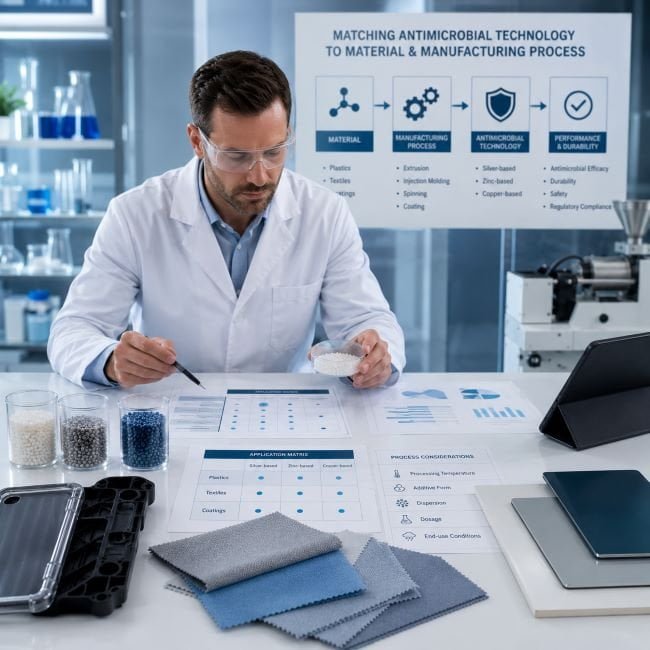
The most useful approach is to connect four factors: the material, manufacturing process, end-use environment, and required antimicrobial performance.
The selection process can follow a simple sequence. First, identify the base material. Then review the production process and processing conditions. Next, define the target microorganisms and required performance. Finally, select the suitable technology, product form, and dosage and confirm the result through testing.
Start with the Material
The host material can affect additive compatibility, dispersion, appearance, and final performance.
For example, a masterbatch designed for one polymer may not be suitable for another because the carrier resin also affects mixing and compatibility. A textile treatment designed for one fiber may also behave differently on another fiber.
The material should therefore be identified before a specific antimicrobial product is selected.
Then Look at the Manufacturing Process
The manufacturing process is the next key consideration.
For plastics, relevant processes can include extrusion, injection molding, film production, and other methods. For textiles, fiber spinning, padding, coating, finishing, drying, and curing may need to be considered. For coatings, mixing, application, and curing can affect additive selection.
Processing temperature is especially important for plastics. The antimicrobial additive should have suitable stability under the actual processing conditions.
The physical form of the additive also affects processing. Powder, liquid, and masterbatch products can offer different advantages depending on the production system.
| Process Factor | What to Check | Why It Matters |
|---|---|---|
| Processing temperature | Actual processing range and additive stability | Helps reduce the risk of thermal degradation |
| Additive form | Powder, liquid, or masterbatch | Affects handling, dosing, and dispersion |
| Carrier compatibility | Masterbatch carrier and host polymer | Supports consistent mixing |
| Dosage | Required addition level | Helps balance performance and formulation cost |
| Final environment | Washing, moisture, UV, cleaning, or abrasion | Helps assess expected durability |
Consider the End-Use Conditions
The conditions after manufacturing can be just as important as the production process.
A plastic component used indoors may face different conditions from an outdoor product. A sports textile may be washed frequently. A coating used in a humid environment may require a different approach from an indoor decorative coating.
Durability should therefore be considered in relation to the actual product life cycle. One antimicrobial technology may perform differently under different environmental conditions.
Use Testing to Confirm the Selection
Testing is an important part of antimicrobial additive selection.
The additive should be tested in the actual formulation or a representative material whenever possible. Other product properties should also be checked, including color, transparency, mechanical performance, processing behavior, and durability.
For customers targeting different markets, applicable regulatory and testing requirements should also be considered early in product development. This can help reduce the risk of reformulation later.
How Langyi Supports Antimicrobial Material Development
Langyi was founded by Dr. Tang, a passionate material scientist who graduated from Tsinghua University. The team focuses on functional additives and material solutions, with an emphasis on practical application and technical support.
The antimicrobial portfolio includes silver-, zinc-, and copper-based technologies for different applications. Langyi also provides antimicrobial additives and masterbatch solutions for plastics, along with solutions for textiles, coatings, films, and other functional materials.
Product selection starts with the customer's material, manufacturing process, target antimicrobial performance, and end-use conditions. These factors help identify a suitable technology and product form.
For plastic applications, Langyi can support the evaluation of direct-addition antimicrobial additives and masterbatch solutions. For textile and coating applications, the material system and application process can also be considered during product selection.
More information about Langyi's antimicrobial solutions is available at www.antimicrobialadditive.com.
The company's mission is to become a hidden champion of the segment industry through professionalism. This means more than supplying functional additives. It means helping customers develop practical material solutions through technical knowledge, application experience, and responsive support.
Conclusion
The right antimicrobial additive balances performance, durability, compatibility, safety, and cost with the material and manufacturing process.