
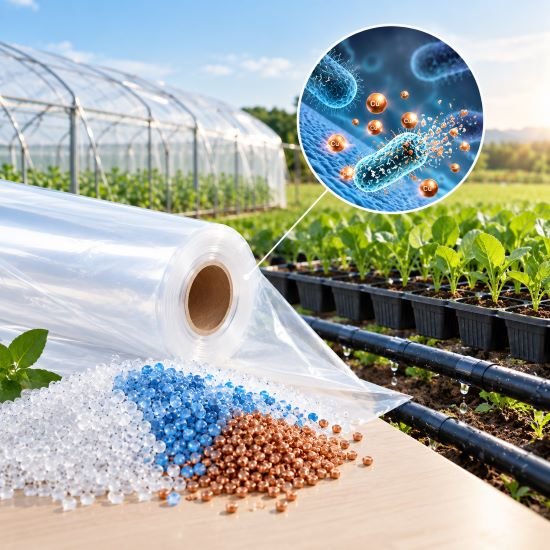
Microbial growth on agricultural materials can contribute to hygiene challenges, biofilm formation, and maintenance costs. Copper-ion antimicrobial additives offer a material-based approach to managing microbial growth on selected surfaces.
By incorporating antimicrobial functionality into agricultural plastics, manufacturers can develop materials designed to help control microbial growth while maintaining the performance required for agricultural use. The effectiveness of these solutions depends on the material, formulation, processing conditions, and intended application.
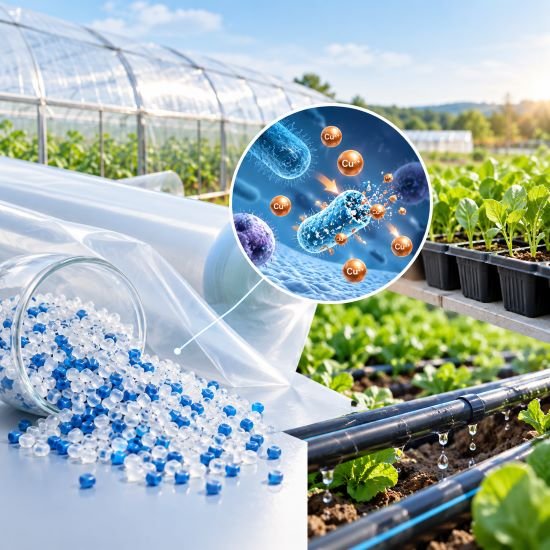
Understanding how copper-ion technology works, where it can be applied, and how it can be integrated into agricultural plastics helps manufacturers evaluate its potential value.
How Do Copper-Ion Antimicrobial Additives Help Control Microbial Growth in Agriculture?
Moisture, organic residues, and repeated contact with plants or soil can create conditions that encourage microbial growth on agricultural materials. In irrigation systems, microbial accumulation may also contribute to biofilm formation and maintenance challenges.
Copper-ion antimicrobial additives can help address microbial growth directly on treated material surfaces. Depending on the formulation, copper ions may interact with microbial cell membranes and interfere with essential cellular processes.
How Copper Ions Interact with Microorganisms
Copper ions can affect microorganisms through several mechanisms:
- Cell membrane damage: Copper ions may disrupt membrane integrity, affecting the cell's ability to maintain normal functions.
- Enzyme and protein interference: Copper ions can interact with cellular proteins and enzymes, disrupting essential metabolic processes.
- Oxidative stress: Under certain conditions, copper can contribute to oxidative damage within microbial cells.
- Effects on genetic material: Copper-related cellular damage may affect DNA and other important cellular components.
The relative contribution of these mechanisms depends on the microorganism, copper formulation, exposure conditions, and material environment.
When incorporated into a suitable polymer or coating, a copper-based antimicrobial additive may provide localized antimicrobial activity at the material surface. Some formulations rely on the availability and release of copper ions, while others may function through different mechanisms.
The performance of a finished product therefore depends on more than the presence of copper alone. Additive concentration, dispersion, surface accessibility, moisture, and processing conditions can all influence the final result.
Built-In Antimicrobial Protection vs. Surface Treatments
Antimicrobial additives incorporated during manufacturing offer a different approach from treatments applied to a finished product.
| Feature | Built-In Antimicrobial Additives | Surface Treatments |
|---|---|---|
| Integration | Incorporated during material manufacturing | Applied to the finished surface |
| Potential durability | May provide activity over an extended service period, depending on formulation and wear | Depends on coating adhesion, washing, abrasion, and environmental exposure |
| Manufacturing considerations | Requires compatibility with the polymer and processing conditions | Requires suitable surface preparation and treatment methods |
| Performance evaluation | Requires testing of the finished material | Requires testing of the treated surface and its durability |
Built-in antimicrobial functionality can be useful where repeated surface exposure makes maintenance difficult. However, it does not automatically guarantee continuous activity throughout a product's entire service life.
Durability, antimicrobial performance, and any potential environmental release should be evaluated under conditions relevant to the intended application.
Where Can Copper-Ion Antimicrobial Additives Be Used in Agricultural Materials?
Agricultural plastics serve a wide range of functions, from protecting crops to transporting water and storing harvested produce. Some of these products encounter frequent moisture, soil, plant residues, or repeated handling, making surface hygiene an important material consideration.
Copper-ion antimicrobial additives may be considered for selected agricultural applications where microbial growth on the material itself is a relevant concern.
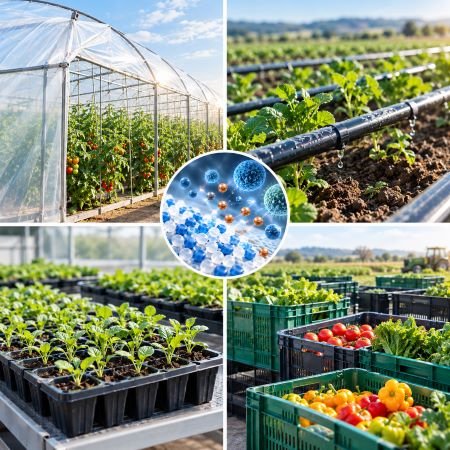
Potential Applications Across Agricultural Plastics
1. Greenhouse Films and Agricultural Covers
Greenhouse films are exposed to moisture, condensation, dust, and organic residues. Depending on the formulation and application, antimicrobial additives may help control microbial growth on selected film surfaces.
However, antimicrobial functionality should not be confused with resistance to all forms of algae, mold, or weathering. UV stability, transparency, mechanical properties, and outdoor durability remain important considerations.
2. Irrigation Pipes and Tubing
Irrigation systems can provide conditions that support biofilm development, particularly where water quality, temperature, and nutrient availability favor microbial growth.
Antimicrobial additives incorporated into suitable pipe or tubing materials may help control microbial growth on treated surfaces. Their ability to reduce biofilm formation or maintain water flow must be established through application-specific testing.
Antimicrobial materials should not be considered a replacement for appropriate irrigation-system cleaning, water treatment, or maintenance.
3. Seedling Trays and Plant Containers
Seedling trays and reusable plant containers are repeatedly exposed to water, growing media, and plant residues.
Antimicrobial additives may help manage microbial growth on selected plastic surfaces and support hygiene between production cycles. Their effectiveness against specific plant pathogens, including organisms associated with damping-off, requires separate evaluation.
4. Harvest and Produce-Handling Crates
Reusable agricultural crates are exposed to moisture, soil, and organic residues during harvesting, transport, and storage.
Antimicrobial additives may help control microbial growth on treated surfaces and support routine cleaning practices. However, they do not independently guarantee longer produce shelf life or food safety.
For food-contact applications, regulatory requirements, migration characteristics, and compatibility with cleaning procedures must be considered.
Agricultural Applications and Key Material Considerations
| Application | Common Material Examples | Key Considerations |
|---|---|---|
| Greenhouse films | PE | Transparency, UV stability, flexibility, outdoor durability |
| Irrigation pipes and tubing | PE, PVC | Biofilm performance, water-contact suitability, pressure resistance |
| Seedling trays | PP, PE | Surface hygiene, impact resistance, repeated-use durability |
| Produce-handling crates | HDPE, PP | Cleanability, abrasion resistance, food-contact compliance where applicable |
The most suitable application depends on the intended function of the product, its exposure conditions, and the antimicrobial performance required.
For agricultural manufacturers, the objective is not necessarily to add antimicrobial functionality to every plastic component. It is to identify where microbial growth on the material surface presents a meaningful challenge and determine whether an antimicrobial solution can address it without compromising other product requirements.
How Can Langyi’s Antimicrobial Additives Be Integrated into Agricultural Plastic Products?
For agricultural plastic manufacturers, introducing an antimicrobial additive involves more than selecting an active ingredient. The additive must work with the polymer, manufacturing process, product design, and intended service environment.
Shanghai Langyi Functional Materials Co., Ltd. develops functional additive solutions for polymer applications. Its antimicrobial technology can be explored as part of a material-development process for products where microbial control is a relevant performance objective.
Learn more about Langyi’s antimicrobial additive solutions.
Selecting an Antimicrobial Additive for Agricultural Materials
Copper-ion technology is one potential approach to antimicrobial material design. The appropriate additive depends on the specific application and the performance requirements of the finished product.
Key factors include:
- Polymer compatibility: The additive should be suitable for the intended resin, such as PE, PP, or PVC, where applicable.
- Processing stability: The active ingredient and carrier system must tolerate the relevant extrusion, molding, or compounding conditions.
- Antimicrobial performance: Efficacy should be evaluated against relevant microorganisms using suitable test methods.
- Durability: Performance should be assessed after exposure to moisture, UV radiation, cleaning, abrasion, or other application-specific conditions.
- Material properties: Mechanical strength, flexibility, appearance, transparency, and other essential characteristics should be maintained as required.
- Regulatory suitability: Agricultural, water-contact, and food-contact applications may have different compliance requirements depending on the product and market.
For manufacturers evaluating copper-based solutions, it is also important to distinguish between copper-ion additives, copper compounds, and other copper-based antimicrobial technologies. Their composition, performance, and suitability may differ.
From Material Requirements to Product Validation
A structured development process can help manufacturers evaluate whether an antimicrobial additive is suitable for their agricultural product.
| Step | Evaluation | Purpose |
|---|---|---|
| 1. Define the application | Polymer, product design, exposure conditions, and microbial concerns | Establish the material and performance requirements |
| 2. Select a suitable additive | Active technology, carrier compatibility, and recommended dosage | Identify a formulation for initial evaluation |
| 3. Conduct processing trials | Extrusion, molding, or other relevant manufacturing conditions | Assess processability and finished-product properties |
| 4. Validate performance | Antimicrobial testing, durability, and material-property testing | Determine suitability for the intended application |
The recommended dosage and processing conditions should be established for the specific formulation and manufacturing process rather than assumed to be universal.
For example, a concentration suitable for one polymer or product geometry may not produce the same results in another. Testing the finished material is therefore essential before making performance claims or moving to commercial production.
Exploring Langyi’s Antimicrobial Solutions
Langyi’s antimicrobial additive portfolio provides a starting point for manufacturers exploring antimicrobial functionality in polymer materials.
For agricultural applications involving copper-ion technology, the appropriate product, active ingredient, carrier system, and recommended processing conditions should be confirmed with Langyi based on the target application.
This approach helps align additive selection with the practical requirements of agricultural plastics, including antimicrobial performance, processing compatibility, durability, and regulatory considerations.
Conclusion
Copper-ion antimicrobial additives offer a potential material-based approach to controlling microbial growth on selected agricultural plastic surfaces.
From greenhouse materials and irrigation components to seedling trays and reusable crates, their suitability depends on the specific microbial challenge, polymer compatibility, exposure conditions, and validated performance.
For agricultural manufacturers, effective antimicrobial material development means balancing antimicrobial activity with durability, processing requirements, and the functional needs of the finished product.
Explore Langyi’s antimicrobial additive solutions to discuss material requirements and potential applications.