

Adding antimicrobial functionality to transparent plastics and coatings presents a common materials challenge: how can manufacturers improve surface hygiene without affecting optical clarity, color, or appearance?
Transparent antimicrobial additives are designed to provide antimicrobial functionality while minimizing changes to the optical properties of the host material. Depending on the technology, this may involve controlling particle size, dispersion, additive concentration, and compatibility with the polymer or coating system.
For manufacturers, the goal is not simply to introduce antimicrobial agents into a transparent material. It is to achieve a practical balance between antimicrobial performance, light transmission, haze, color stability, and processing requirements. Understanding the relationship between these factors is essential when developing transparent antimicrobial products.
Why Is Optical Clarity Important in Transparent Plastic and Coating Applications?
Optical clarity is a critical performance characteristic in many plastic and coating applications. Even relatively small changes in transparency, haze, or color can affect product functionality, appearance, and market acceptance.
Transparent materials are widely used in products where visibility is essential, including packaging, electronics, medical equipment, optical components, and protective coatings.

In these applications, clarity serves two important purposes: functional visibility and aesthetic quality.
Functional Requirements for Transparency
For some products, transparency directly affects how well the product performs.
- Electronics: Screen protectors, display covers, and optical components require suitable light transmission and low haze to maintain visual quality.
- Food packaging: Transparent films and containers allow consumers and quality-control personnel to inspect the packaged contents.
- Medical devices: Certain fluid containers, tubing, and diagnostic components require sufficient transparency for visual monitoring.
- Protective coatings: Clear coatings should preserve the appearance of the underlying surface while providing the intended protective properties.
In these applications, haze, discoloration, or reduced light transmission may interfere with the product's intended function.
Aesthetic Value and Product Perception
Transparency also influences how consumers perceive product quality. Clear materials are often associated with cleanliness, precision, and modern design.
For example, a transparent water bottle, cosmetic container, or electronic accessory may lose some of its visual appeal if an additive introduces cloudiness or visible particles.
| Application area | Functional requirement | Optical consideration |
|---|---|---|
| Electronics | Screen and component visibility | High light transmission and low haze |
| Food packaging | Visual inspection of contents | Clarity and color stability |
| Medical devices | Visibility of fluids and internal components | Consistent transparency and appearance |
| Protective coatings | Visibility of the underlying surface | Low haze and minimal color change |
For manufacturers, maintaining optical performance is therefore an important part of additive selection. An antimicrobial solution must be evaluated not only for its intended functionality but also for its effect on the finished material.
How Do Transparent Antimicrobial Additives Maintain Clarity While Providing Antimicrobial Performance?
Incorporating antimicrobial functionality into transparent materials requires careful control of how the additive interacts with light and the host material.
Light scattering is one of the main causes of haze in transparent plastics. When light encounters particles, interfaces, or other structural variations within a material, some of it may be redirected rather than transmitted directly. The extent of scattering depends on several factors, including particle size, particle distribution, refractive-index differences, concentration, and material structure.
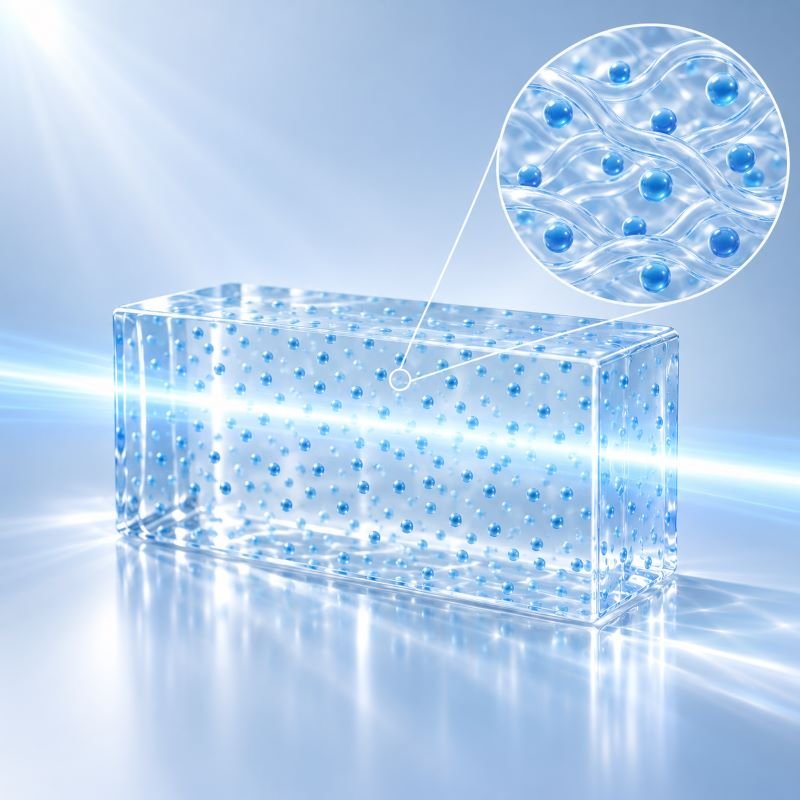
For this reason, transparent antimicrobial formulations are not defined by particle size alone. They require an appropriate combination of additive characteristics and material formulation.
Key Approaches to Maintaining Transparency
Several material-design strategies can help minimize the optical impact of antimicrobial additives.
1. Particle Size and Distribution
The size of additive particles and their distribution within the host material can influence light scattering.
Particles substantially smaller than visible-light wavelengths may scatter less light under suitable conditions. However, small primary particles can still form larger agglomerates during compounding or processing, potentially increasing haze.
Effective dispersion is therefore just as important as the original particle size. Manufacturers should evaluate the particle distribution in the finished material rather than relying only on the additive's initial particle-size specification.
2. Refractive Index Compatibility
The refractive index describes how light propagates through a material. When an additive and its surrounding polymer have significantly different refractive indices, their interfaces can contribute to light scattering.
Selecting an additive system with suitable refractive-index compatibility can help reduce this effect. The actual result depends on the additive's composition, particle structure, concentration, and the optical properties of the host polymer.
3. Additive Concentration and Formulation
Increasing additive concentration may improve antimicrobial performance in some formulations, but it can also affect transparency, color, and mechanical properties.
The appropriate loading level should therefore be determined through application-specific testing. The objective is to achieve the required antimicrobial performance while maintaining the optical specifications of the finished product.
4. Solubility and Material Compatibility
Some antimicrobial agents can be incorporated through compatible soluble or molecularly dispersed systems. Where the active substance is genuinely compatible with the polymer, the absence of separate particulate domains may help minimize light scattering.
However, solubility does not automatically guarantee optical stability. Additive migration, phase separation, crystallization, or changes during aging may still affect the material's appearance.
Comparison of Approaches for Transparent Formulations
| Approach | How it works | Optical considerations |
|---|---|---|
| Fine-particle design | Uses appropriately sized antimicrobial particles | Smaller particles may reduce scattering, provided agglomeration is controlled |
| Refractive-index compatibility | Reduces optical contrast between the additive and host material | May help minimize scattering at material interfaces |
| Improved dispersion | Distributes the additive more uniformly throughout the material | Helps prevent visible agglomerates and localized haze |
| Compatible soluble systems | Incorporates an antimicrobial agent in a compatible dissolved or dispersed state | May reduce particle-related scattering, but compatibility and migration require evaluation |
Balancing Antimicrobial Performance and Optical Properties
Maintaining transparency is only one part of the formulation challenge. The additive must also provide measurable antimicrobial performance against the microorganisms relevant to the intended application.
For example, silver-based antimicrobial technologies can work through the interaction of silver ions with microbial cell components, potentially interfering with essential cellular functions and inhibiting the growth of susceptible microorganisms.
However, antimicrobial performance depends on the active agent, its availability at the material surface, the polymer formulation, and test conditions. A transparent formulation should therefore be evaluated for both optical properties and antimicrobial efficacy.
Langyi provides inorganic antimicrobial additive solutions for selected polymer and material applications. Manufacturers can explore Langyi's antimicrobial additive solutions when evaluating potential options for transparent material formulations.
What Should Manufacturers Consider When Selecting Antimicrobial Additives for Clear Materials?
An additive that appears transparent in its original form may not maintain the same optical performance after compounding, molding, extrusion, or long-term use.
Manufacturers should evaluate the complete formulation and finished product rather than relying solely on the appearance or specifications of the additive itself.
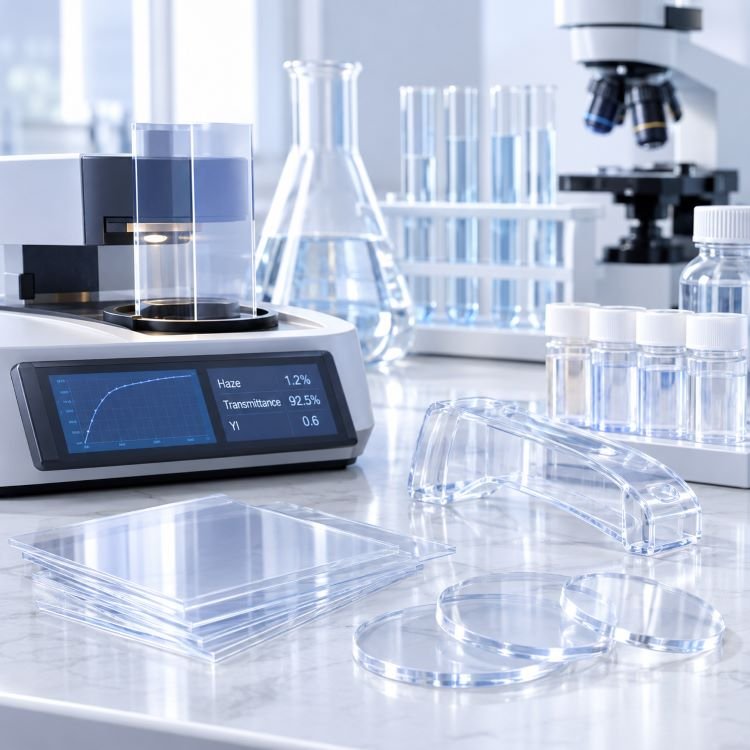
The selection process should consider optical performance, antimicrobial efficacy, processing stability, material compatibility, durability, and regulatory requirements.
A Checklist for Long-Term Performance
1. Initial Optical Clarity
Measure the optical properties of the finished material, including light transmission, haze, and color. ASTM D1003 is commonly used to evaluate haze and luminous transmittance of transparent plastics.
Testing should compare the antimicrobial formulation with an appropriate control sample under consistent conditions.
2. Long-Term Color and UV Stability
Transparent plastics may undergo color changes when exposed to heat, UV radiation, or environmental aging. Additives can also influence these changes depending on their chemical composition and interactions with the polymer.
Accelerated aging and weathering tests can help assess whether the formulation maintains acceptable color and optical properties over time.
3. Processing Stability
The additive must withstand the actual manufacturing conditions, including processing temperature, residence time, shear, and cooling conditions.
For injection molding and extrusion, processing trials can help identify potential discoloration, agglomeration, or changes in optical performance.
4. Material Compatibility
The additive should be compatible with the selected polymer or coating system. Testing should assess possible effects on transparency, flexibility, impact strength, tensile properties, and other application-specific requirements.
5. Antimicrobial Efficacy
Antimicrobial performance should be verified using appropriate test methods and target microorganisms. For non-porous plastic surfaces, methods such as ISO 22196 or JIS Z 2801 may be relevant, depending on the application and test requirements.
The test method should reflect the intended use as closely as possible. Results from one material or test condition should not automatically be generalized to other formulations or applications.
6. Regulatory and Application Requirements
Regulatory requirements depend on the active substance, product category, antimicrobial claims, and intended market.
For example, food-contact packaging and medical-device applications may require additional material safety assessments and regulatory review. Antimicrobial claims may also trigger specific requirements in different markets.
Manufacturers should verify the regulatory status of the complete formulation and finished product rather than assuming that an additive's general compliance information covers every end use.
Practical Evaluation Checklist
| Selection factor | Key question | Why it matters |
|---|---|---|
| Light transmission and haze | Does the finished material meet the required optical specifications? | Helps maintain visibility and product appearance |
| Color stability | Does the material retain its appearance after heat, UV, and aging exposure? | Reduces the risk of discoloration |
| Particle dispersion | Are additive particles uniformly distributed without significant agglomeration? | Helps minimize haze and optical defects |
| Processing stability | Can the additive withstand actual extrusion or molding conditions? | Supports consistent manufacturing quality |
| Material compatibility | Does the additive affect mechanical or physical properties? | Helps preserve the material's intended performance |
| Antimicrobial efficacy | Does the formulation demonstrate the required activity against target microorganisms? | Confirms that the additive provides the intended functionality |
| Regulatory suitability | Does the finished product meet requirements for its intended application and market? | Supports product safety and market access |
Why Application-Specific Testing Matters
There is no universal transparent antimicrobial additive suitable for every clear polymer or coating. Different materials have different optical properties, processing temperatures, and compatibility requirements.
For example, an additive formulation suitable for one transparent polymer may produce unacceptable haze or color changes in another. Similarly, a concentration that meets antimicrobial performance requirements in one application may not be appropriate for a product with stricter optical specifications.
A practical development process should include:
- Defining the required optical and antimicrobial performance.
- Screening candidate additives for compatibility with the host material.
- Preparing trial formulations at different additive concentrations.
- Evaluating optical properties and antimicrobial efficacy.
- Conducting processing and aging tests using representative conditions.
- Confirming that the finished product meets applicable safety and regulatory requirements.
This approach helps manufacturers identify a suitable balance between antimicrobial functionality and optical quality before moving to large-scale production.
Conclusion
Transparent antimicrobial additives can introduce antimicrobial functionality into clear plastics and coatings, but maintaining optical performance requires careful formulation and validation.
Particle size, dispersion, refractive-index compatibility, additive concentration, and polymer selection all influence the final result. Long-term performance also depends on processing stability, material compatibility, aging behavior, and regulatory suitability.
For manufacturers, the objective is not simply to make an antimicrobial additive invisible, but to develop a formulation that delivers the required antimicrobial performance while preserving the clarity and functional properties of the finished product.
To learn more about inorganic antimicrobial technologies and potential solutions for polymer applications, visit Langyi's official website.