
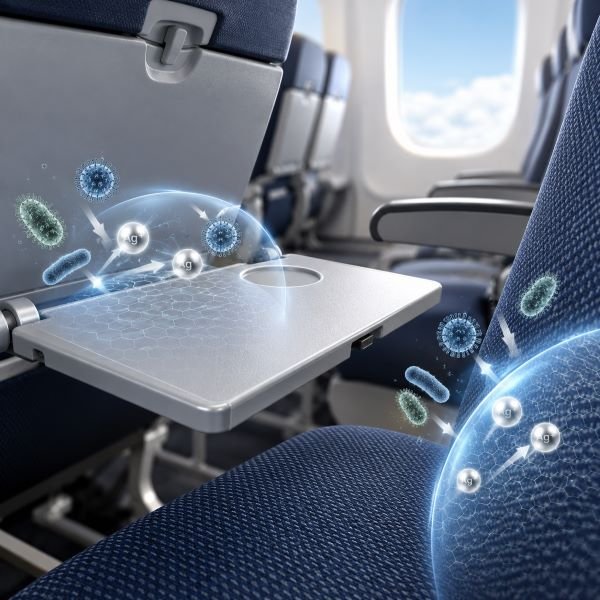
Concern about cabin hygiene continues to influence how airlines, aircraft manufacturers, and material suppliers approach frequently touched interior surfaces. Routine cleaning remains essential, but antimicrobial additives can provide an additional layer of protection by integrating antimicrobial functionality directly into materials.
For aircraft interiors, this approach is particularly relevant to components such as tray tables, seat fabrics, armrests, and other frequently handled surfaces. Instead of relying only on treatments applied after manufacturing, antimicrobial additives can be incorporated into plastics, textiles, coatings, or other materials during production.
Silver-ion antimicrobial technologies are one option for this built-in approach. Depending on the material system and formulation, they can help inhibit microbial growth on or within treated materials while maintaining the functional properties required for the application.
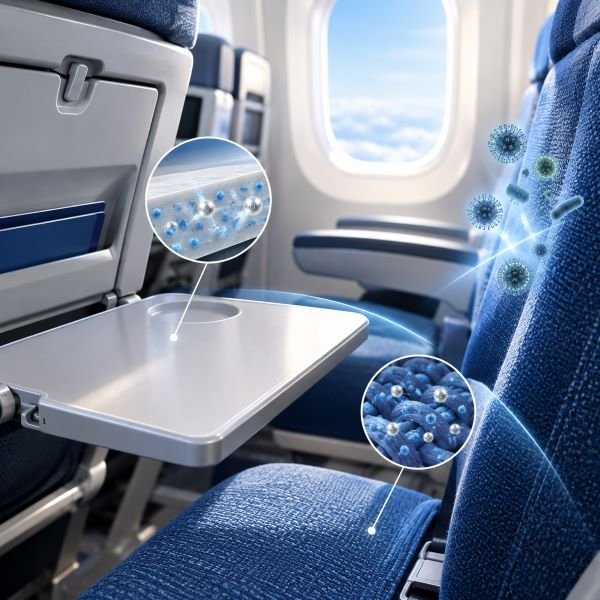
The key question is not simply whether an aircraft surface can be treated with an antimicrobial technology, but where antimicrobial protection provides the most value and how the technology can remain compatible with the material throughout its service life.
Why Are Aircraft Tray Tables and Seat Fabrics Important Targets for Antimicrobial Protection?
Aircraft cabins contain many high-contact surfaces that are repeatedly exposed to passengers, food, beverages, moisture, and routine cleaning. Tray tables and seat fabrics represent two different material challenges when developing cabin hygiene strategies.
The Tray Table: A Frequently Touched Hard Surface
Tray tables can be used for eating, drinking, working, and handling personal belongings. Their frequent contact with hands and other objects makes them an important consideration when developing cabin hygiene strategies.
Many tray tables use engineering plastics such as ABS or polycarbonate because of their balance of strength, weight, durability, and processability. However, repeated use and cleaning can gradually change a surface through abrasion or micro-scratching.
An antimicrobial additive incorporated during polymer processing can provide antimicrobial functionality within the material system rather than relying exclusively on a surface treatment applied after manufacturing.
The Seat Fabric: A Different Material Challenge
Seat fabrics have a different risk profile because textile structures can retain moisture and particulate contaminants within or between fibers.
Sweat, food residues, spills, and repeated passenger contact can create conditions that support microbial growth if moisture and other environmental factors are suitable. Cleaning and disinfection remain important, but the ability to integrate antimicrobial functionality into the textile itself can provide an additional layer of material protection between cleaning cycles.
The distinction between hard and soft surfaces is therefore important when selecting an antimicrobial additive.
| Material | Typical Hygiene Challenge | Antimicrobial Design Consideration |
|---|---|---|
| Tray Table / Plastic | Frequent hand contact, food and beverage exposure, repeated cleaning | Polymer compatibility, dispersion, surface performance, cleaning resistance |
| Seat Fabric / Textile | Moisture retention, repeated contact, stains and odors | Fiber or coating compatibility, wash durability, handle and appearance |
This also explains why one antimicrobial formulation should not automatically be applied to every aircraft interior material. The additive, dosage, processing method, and performance requirements need to be matched to the specific material system.
How Can Silver-Ion Antimicrobial Additives Provide Long-Lasting Protection?
Surface disinfectants and antimicrobial treatments can be useful tools, but their effectiveness depends on application frequency, coverage, and the durability of the treatment.
By contrast, an antimicrobial additive can be incorporated into the material during manufacturing. This approach can provide antimicrobial functionality that is integrated with the material rather than relying solely on a treatment applied to the outermost surface.
How Silver Ions Interact with Microorganisms
Silver-ion antimicrobial technologies generally rely on the controlled availability of Ag+ ions. Under suitable conditions, released silver ions can interact with microbial cells and interfere with multiple cellular processes, including membrane function and enzyme activity.
The precise mechanism and antimicrobial performance depend on the silver technology, carrier system, polymer or textile matrix, environmental conditions, and formulation.
This makes formulation engineering just as important as the antimicrobial active itself.
Integrating Antimicrobial Protection into the Material
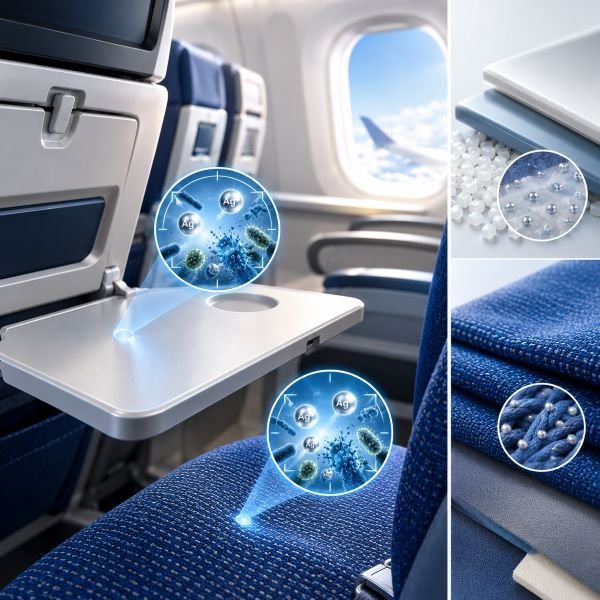
For plastic aircraft components, a silver-based antimicrobial additive can be incorporated into a masterbatch or directly into the polymer formulation before molding or extrusion.
For textile applications, antimicrobial functionality may be introduced through fiber incorporation, coating, or other textile finishing technologies, depending on the material and manufacturing process.
The objective is to create durable antimicrobial functionality that is integrated with the material, rather than relying solely on a treatment that remains on the outermost surface.
Langyi's Silver-Ion Antimicrobial Solutions
For manufacturers developing antimicrobial plastic or textile applications, Shanghai Langyi Functional Materials offers inorganic antimicrobial additive solutions designed for incorporation into material systems.
Langyi's silver-based antimicrobial technologies can be considered for applications where manufacturers need to balance antimicrobial performance, material compatibility, processing requirements, and durability.
The focus is not simply on adding an antimicrobial agent to a material, but on selecting a formulation that works with the polymer, textile, coating, manufacturing process, and intended service environment.
What Should Manufacturers Consider When Choosing Antimicrobial Additives for Aircraft Interiors?
Antimicrobial efficacy is only one part of the selection process for aircraft interior materials.
Aircraft components must continue to meet their functional and material requirements after antimicrobial additives are introduced. This can include appearance, mechanical properties, processability, chemical resistance, cleaning resistance, and other application-specific requirements.
For antimicrobial additives, manufacturers should therefore evaluate the complete material system rather than antimicrobial activity alone.
| Selection Factor | Key Question | Why It Matters |
|---|---|---|
| Antimicrobial Performance | Does the additive provide the required level of microbial-growth inhibition? | Determines whether the technology meets the intended application objective |
| Material Compatibility | Does it affect color, strength, surface properties, or texture? | Protects the original performance of the aircraft material |
| Durability | Does performance remain after cleaning, abrasion, or normal use? | Helps maintain functionality throughout the intended service period |
| Processability | Can it be incorporated into the existing manufacturing process? | Reduces unnecessary changes to production |
| Regulatory & Application Requirements | Does the finished material meet the requirements applicable to its intended market and aircraft application? | Supports appropriate qualification and market access |
Regulatory Considerations Matter as Much as Antimicrobial Performance
Aviation materials are subject to demanding application-specific requirements, and antimicrobial functionality does not replace the need for material qualification.
Aircraft interior materials may need to be evaluated for properties such as flammability, smoke, toxicity, chemical resistance, corrosion, durability, and compatibility with cleaning procedures.
Antimicrobial-treated materials may also be subject to chemical and biocidal regulations in their target markets. In the EU, the Biocidal Products Regulation (BPR) establishes requirements for articles treated with or intentionally incorporating biocidal products.
In the United States, EPA requirements distinguish qualifying treated articles from antimicrobial pesticide products and place limits on certain public-health claims associated with treated articles.
For this reason, antimicrobial claims, regulatory status, and the intended end use should be evaluated together rather than treated as separate issues.
From Routine Cleaning to Material-Based Hygiene Protection
Aircraft cabin hygiene will continue to depend on multiple measures, including cleaning, disinfection, material selection, cabin maintenance, and operational procedures.
Antimicrobial additives offer another layer within this broader strategy by integrating antimicrobial functionality into the materials themselves.
For tray tables, this can mean incorporating antimicrobial technology into engineering plastics during processing. For seat fabrics, the approach may involve fiber incorporation or a compatible antimicrobial textile treatment. In both cases, the goal is to develop materials that can support hygiene management without compromising their primary functional requirements.
The most practical approach is therefore not to replace routine cleaning, but to combine established cleaning procedures with appropriately designed antimicrobial materials.
A Material-First Approach to Aircraft Hygiene
For aircraft interior manufacturers and material suppliers, the central question is increasingly how antimicrobial performance can be built into the material while maintaining durability, processability, appearance, and regulatory suitability.
Langyi's antimicrobial additive technologies provide material manufacturers with options for developing antimicrobial plastics, textiles, and other functional material systems.
Explore Langyi's antimicrobial additive solutions to learn more about silver-based and other inorganic antimicrobial technologies for material applications.