

Biodegradable plastics offer a more sustainable material option, but microbial growth can still cause odors, staining, and surface biofilm during use. The challenge is finding antimicrobial protection that works without compromising the material's intended performance or end-of-life pathway.
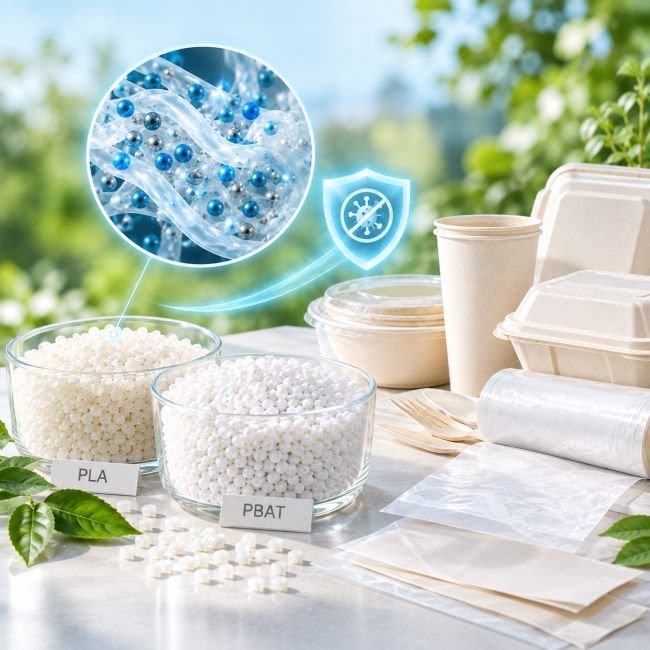
Antimicrobial additives can help PLA and PBAT biodegradable plastics control unwanted microbial growth on or within the material during their service life. When properly selected and formulated, they can support cleaner surfaces, odor control, and longer-lasting product performance while allowing the material to retain its designed biodegradation characteristics.
As demand grows for biodegradable packaging, films, consumer products, and other sustainable plastic applications, antimicrobial functionality is becoming an additional material-performance consideration. The key is not simply adding an antimicrobial agent, but selecting a solution that is compatible with the polymer, processing conditions, target microorganisms, and intended end-of-life requirements.
Why Do PLA and PBAT Biodegradable Plastics Need Antimicrobial Protection?
PLA and PBAT are widely used in biodegradable and compostable plastic formulations, including films, bags, packaging, agricultural products, and other consumer applications. However, biodegradability does not automatically provide protection against microbial growth during the product's service life.
When moisture, nutrients, temperature, and other favorable conditions are present, microorganisms can colonize plastic surfaces. Depending on the application, this may contribute to unpleasant odors, discoloration, surface contamination, or biofilm formation.
For products expected to remain clean and functional for a defined period, controlling unwanted microbial growth can therefore become an important part of material design.
Service Life and End-of-Life Are Different Requirements
One of the most important considerations is the distinction between service-life performance and end-of-life biodegradation.
During use, a PLA or PBAT product may need to maintain its appearance, mechanical integrity, and surface hygiene. At the end of its intended service life, however, the material may be directed toward a specific biodegradation or composting pathway.
An antimicrobial additive should therefore be evaluated not only for its antimicrobial efficacy, but also for how its chemistry interacts with the polymer, manufacturing process, regulatory requirements, and intended end-of-life conditions.
The objective is not to "stop biodegradation" during use. Rather, the objective is to provide appropriate antimicrobial protection while preserving the material properties and end-of-life characteristics required for the specific application.
Common Microbial Challenges in Use
| Challenge | Potential Impact on Biodegradable Plastics |
|---|---|
| Odor | Microbial activity can contribute to unpleasant odors, particularly in humid or organic-rich environments. |
| Staining & Discoloration | Bacteria, fungi, and other microorganisms may contribute to visible surface contamination or discoloration. |
| Biofilm Formation | Repeated exposure to moisture and microorganisms can promote microbial attachment and biofilm development. |
| Surface Hygiene | High-contact or moisture-prone products may require additional protection to maintain cleaner surfaces during use. |
Antimicrobial additives can address these challenges by creating an environment that inhibits the growth or proliferation of targeted microorganisms. The actual performance depends on the antimicrobial chemistry, dosage, polymer matrix, processing conditions, and application environment.
Can Antimicrobial Additives Preserve the Performance and Biodegradability of PLA and PBAT?
A common concern is whether adding an antimicrobial agent undermines the sustainability advantages of biodegradable plastics.
The answer depends on which antimicrobial additive is used, how much is added, how it interacts with the polymer, and what end-of-life requirements apply to the finished product.
A well-designed formulation aims to achieve antimicrobial performance without unnecessarily changing the mechanical, thermal, optical, or processing characteristics of PLA or PBAT. At the same time, biodegradation or compostability should not be assumed simply because the base polymer is biodegradable.
Balancing Antimicrobial Performance with Material Properties
The relationship between antimicrobial protection and biodegradability is better understood as a formulation balance:
- Antimicrobial efficacy: Does the additive provide the required level of microbial control?
- Polymer compatibility: Does it disperse uniformly throughout the PLA or PBAT matrix?
- Processing stability: Can it withstand the relevant extrusion, compounding, molding, or film-processing conditions?
- Mechanical performance: Does the formulation maintain the required strength, flexibility, and durability?
- Appearance: Does the additive affect color, transparency, surface finish, or other visual requirements?
- End-of-life performance: Has the finished formulation been evaluated against the relevant biodegradation or compostability requirements?
This is why antimicrobial selection should be based on the complete material system, rather than antimicrobial activity alone.
Antimicrobial Additives from Langyi
Shanghai Langyi Functional Materials provides inorganic antimicrobial additive solutions based on technologies including silver, zinc, and copper ions. These additives are designed for incorporation into polymer materials and can be evaluated according to the specific polymer, processing method, antimicrobial target, and application requirements.
For PLA and PBAT formulations, the appropriate antimicrobial solution can be selected by considering factors such as processing temperature, additive dispersion, required antimicrobial performance, dosage, and compatibility with the overall formulation.
Learn more about Langyi's antimicrobial additive solutions
It is important to note that the suitability of an antimicrobial additive for a biodegradable or compostable product should be confirmed through application-specific testing. Base-polymer biodegradability alone does not establish the biodegradability or compostability of the final additive-containing formulation.
How to Choose Antimicrobial Additives for PLA and PBAT Applications?
Selecting an antimicrobial additive for PLA or PBAT requires more than comparing antimicrobial activity data. The additive needs to function effectively within the actual manufacturing process and final application.
A practical evaluation can start with five questions:
-
What microorganisms need to be controlled?
The target may include specific bacteria, fungi, or other microorganisms depending on the product and environment. -
What processing conditions will the material experience?
Extrusion, compounding, injection molding, thermoforming, and film processing can expose additives to elevated temperatures and shear. -
How well does the additive disperse in PLA or PBAT?
Uniform dispersion is important for consistent antimicrobial performance and stable material properties. -
What are the regulatory and end-use requirements?
Food-contact, consumer-product, medical, agricultural, and other applications may have different regulatory requirements in different markets. -
What are the end-of-life requirements?
If a product is marketed as biodegradable or compostable, the complete formulation should be assessed against the applicable standards and certification requirements rather than relying only on the properties of PLA or PBAT.
Processing Compatibility Matters
PLA and PBAT are processed under elevated temperatures, but actual processing windows vary according to polymer grade, formulation, equipment, and manufacturing process.
The antimicrobial additive therefore needs to be evaluated under the actual processing conditions rather than against a generic temperature range.
Thermal stability is only one consideration. Other factors include:
- Dispersion within the polymer matrix
- Interaction with other additives
- Effect on melt processing
- Color and transparency requirements
- Mechanical properties
- Long-term antimicrobial performance
- Compatibility with the intended end-use environment
For example, an additive that performs well in a laboratory screening test may not deliver the same result after compounding or film extrusion if it has poor dispersion or insufficient processing stability.
Regulatory and Sustainability Considerations
For applications such as food packaging, disposable tableware, agricultural films, or consumer products, regulatory requirements should be assessed according to the specific market, product category, antimicrobial substance, and intended use.
References to regulations such as FDA requirements in the United States, EU requirements, or biocidal regulations should therefore be treated as application-specific rather than as blanket approval for an antimicrobial additive.
The same principle applies to biodegradability and compostability.
A PLA or PBAT product containing an antimicrobial additive should not automatically be described as compostable simply because PLA or PBAT itself has biodegradable characteristics. The complete formulation, intended disposal environment, applicable testing methods, and certification requirements need to be considered.
A Practical Selection Checklist
| Selection Factor | Key Question |
|---|---|
| Antimicrobial Performance | Which microorganisms need to be controlled, and what level of performance is required? |
| Processing Compatibility | Can the additive withstand the actual compounding and processing conditions? |
| Polymer Compatibility | Does it disperse effectively in the PLA, PBAT, or blend system? |
| Material Performance | Does it maintain the required mechanical, thermal, optical, and processing properties? |
| Regulatory Requirements | Is the formulation suitable for the intended application and target market? |
| End-of-Life Requirements | Has the complete formulation been evaluated against the relevant biodegradation or compostability requirements? |
| Cost in Use | Does the required dosage provide a practical balance between performance and formulation cost? |
Designing Antimicrobial PLA and PBAT for Real-World Applications
The value of antimicrobial additives becomes clearer when biodegradable plastics are exposed to real-world conditions.
Potential applications include:
- Biodegradable packaging films — helping manage microbial growth during storage and handling.
- Food-related packaging components — where surface hygiene and regulatory compliance may be important considerations.
- Disposable tableware and consumer products — supporting cleaner surfaces during their intended period of use.
- Agricultural biodegradable films — where moisture and microbial exposure are part of the operating environment.
- Compostable bags and liners — where antimicrobial performance during use must be considered alongside the intended end-of-life pathway.
For each application, the formulation should be optimized around the actual material grade, processing technology, antimicrobial target, and service environment.
Why Antimicrobial Additive Selection Should Be Application-Specific
There is no single antimicrobial additive that automatically fits every PLA or PBAT formulation.
Silver-, zinc-, and copper-based inorganic antimicrobial technologies can offer different performance characteristics, processing considerations, and cost profiles. The appropriate choice depends on the polymer system and the requirements of the finished product.
For manufacturers developing antimicrobial PLA or PBAT products, supplier support can therefore play an important role in formulation development. Testing should ideally evaluate the additive in the actual polymer formulation and manufacturing process, rather than relying only on data generated from a different material system.
Explore Langyi's antimicrobial additive solutions
Langyi works with customers to evaluate antimicrobial additive solutions according to polymer compatibility, processing conditions, target applications, and required antimicrobial performance. This application-oriented approach can help manufacturers integrate antimicrobial functionality into biodegradable plastic products while maintaining focus on material performance and end-of-life requirements.
Conclusion
Antimicrobial additives can provide an additional layer of functionality for PLA and PBAT biodegradable plastics, particularly where moisture, microbial exposure, odor, staining, or surface hygiene are important considerations.
The key is not simply to add an antimicrobial agent. Effective formulation requires a balance between microbial control, polymer compatibility, processing stability, material performance, regulatory requirements, and the intended biodegradation or composting pathway.
For biodegradable plastics, effective antimicrobial protection is not about adding more—it is about finding the right balance between microbial control, material performance, and biodegradability.
If you are developing antimicrobial PLA, PBAT, or other biodegradable polymer products, contact Langyi to discuss an antimicrobial additive solution matched to your material and application requirements.