
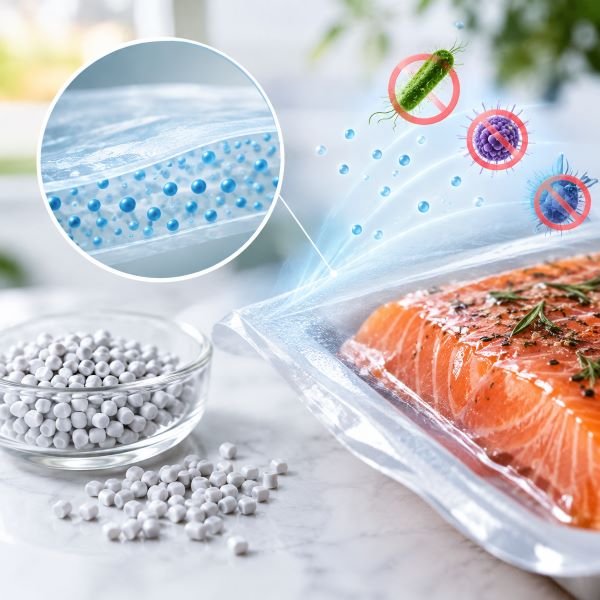
Food spoilage increases waste, reduces product quality, and creates challenges across the food supply chain. Antimicrobial additives in packaging films can help control microbial growth and support longer-lasting food freshness.
Active antimicrobial packaging incorporates functional additives into packaging materials to help inhibit the growth of targeted microorganisms. Depending on the formulation, food type, and packaging conditions, this technology can help slow microbial spoilage and extend shelf life while maintaining product quality.
However, effective antimicrobial packaging requires more than simply adding an antimicrobial agent to a plastic film. Understanding how these additives work, which technologies suit different applications, and how to integrate them into packaging materials is essential for developing reliable solutions.
How Do Antimicrobial Packaging Films Help Extend Food Shelf Life?
Antimicrobial packaging films help manage microbial growth by incorporating active substances that inhibit targeted bacteria, yeasts, or molds. Depending on the technology, these substances may act at the film surface, be released into the surrounding environment, or become active through contact with microorganisms.
Unlike conventional packaging, which primarily provides a physical barrier against external contamination and environmental factors, active antimicrobial packaging adds a functional layer of microbial control. Its effectiveness depends on the antimicrobial agent, food composition, moisture conditions, storage temperature, and the microorganisms present.
Understanding the Antimicrobial Mechanism
The mechanism varies according to the additive and packaging design. Some systems release antimicrobial substances gradually, while others are designed to act primarily at the material surface. These approaches can help target microbial growth where contamination or spoilage is most likely to occur.
For example, silver-ion-based technologies can interfere with several essential microbial processes. Silver ions may interact with microbial cell membranes and proteins, disrupting normal cellular functions. Their activity depends on factors such as ion availability, concentration, and the surrounding environment.
Other antimicrobial agents may interfere with cell membranes, metabolic pathways, or other processes necessary for microbial growth and reproduction.
The objective is to achieve effective microbial control without compromising the packaging's mechanical properties, food quality, or regulatory compliance.
It is important to note that antimicrobial packaging does not replace refrigeration, good manufacturing practices, or appropriate food-handling procedures. Its role is to complement existing food preservation and safety measures.
Which Antimicrobial Additives Are Suitable for Food Packaging Films?
Selecting an antimicrobial additive requires balancing antimicrobial performance, polymer compatibility, processing stability, cost, and food-contact requirements. No single technology is suitable for every food packaging application.
Silver-based compounds, zinc-based materials, and selected natural antimicrobial substances are among the technologies investigated for active packaging. Their suitability depends on the intended application and the applicable regulatory requirements.
Silver-Based Antimicrobial Additives
Silver-based antimicrobial technologies are valued for their activity against a range of microorganisms. In suitable formulations, silver ions can interfere with essential microbial functions and help inhibit microbial growth.
For plastic packaging films, important selection criteria include the availability of active silver ions, dispersion within the polymer, stability during processing, and the antimicrobial performance of the finished material.
Silver-based additives may be worth evaluating for packaging applications where microbial control is a priority. However, their effectiveness and suitability must be verified in the intended packaging system, particularly where direct or indirect food contact is involved.
Langyi's inorganic antimicrobial additive solutions include silver-based technologies designed for incorporation into functional material systems. These solutions can be evaluated for compatibility with specific polymers and manufacturing processes.
Explore Langyi's silver antimicrobial agents to learn more about available technologies and potential material applications.
Zinc-Based and Other Antimicrobial Technologies
Zinc-based materials, including zinc oxide, are also investigated for antimicrobial applications. Their performance can vary considerably with particle characteristics, formulation, concentration, and the surrounding environment.
Natural antimicrobial substances may appeal to applications seeking bio-based ingredients, but their volatility, thermal stability, odor, taste effects, and compatibility with film processing need careful assessment.
Food-contact suitability should never be assumed solely from an ingredient's general safety status or its antimicrobial performance. The finished packaging formulation and intended conditions of use must meet the applicable regulatory requirements.
The following comparison summarizes key considerations when evaluating antimicrobial technologies.
| Antimicrobial technology | Potential advantages | Key considerations |
|---|---|---|
| Silver-based additives | Activity against a range of microorganisms; potential for durable performance in suitable formulations | Cost, ion availability, migration, dispersion, and regulatory compliance |
| Zinc-based materials | Potential antimicrobial functionality; certain formulations may provide additional material properties | Efficacy against target microorganisms, particle dispersion, processing, and food-contact compliance |
| Natural antimicrobial substances | Potential for bio-based formulations and specific application needs | Thermal stability, odor or taste effects, release behavior, and consistency |
The appropriate choice should be based on the target microorganisms, food characteristics, polymer type, processing conditions, and required shelf-life performance—not simply on the additive category.
Explore Langyi's Zinc antimicrobial agents.
How Can Antimicrobial Additives Be Integrated into Food Packaging Materials?
Once a suitable antimicrobial technology has been identified, the next challenge is integrating it into the packaging material without compromising film performance.
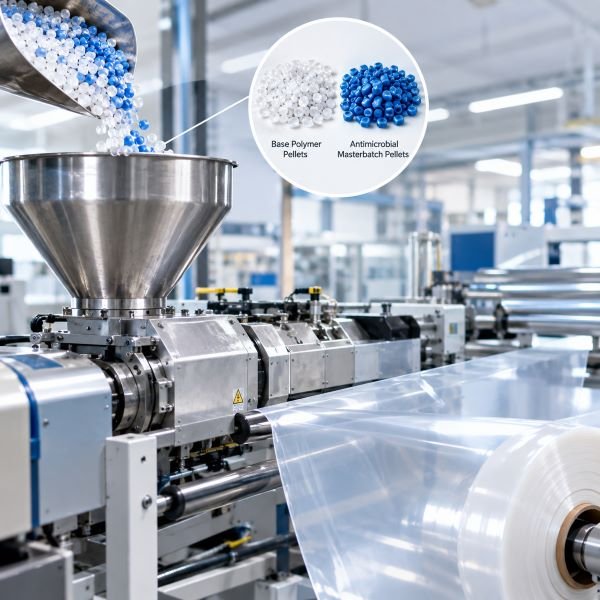
For many thermoplastic applications, a masterbatch offers a practical route for introducing functional additives during manufacturing. A masterbatch contains a concentrated additive dispersed in a compatible carrier resin. It can be blended with the base polymer before film extrusion.
Masterbatch Integration and Film Processing
The general integration process includes three stages:
- Dosing and blending: The antimicrobial masterbatch is combined with the base polymer at a formulation-specific loading level.
- Extrusion and dispersion: The blend is processed under suitable temperature and mixing conditions to achieve consistent additive distribution.
- Film formation and validation: The material is converted into film, followed by testing to assess antimicrobial performance, mechanical properties, appearance, and other application requirements.
The appropriate masterbatch concentration depends on the additive's activity, carrier resin, film structure, processing conditions, and target performance. A universal dosage should not be assumed without formulation trials and technical guidance.
Explore Langyi's antimicrobial masterbatch
Key Factors for Successful Integration
Antimicrobial functionality must be developed alongside the film's core performance requirements. Several factors deserve particular attention:
- Polymer compatibility: The carrier and additive should be suitable for the target resin, such as polyethylene (PE) or polypropylene (PP).
- Processing stability: The active ingredient must withstand the relevant extrusion temperature and processing conditions.
- Dispersion and film quality: Uniform distribution helps reduce performance variability and minimize unwanted effects on appearance or mechanical properties.
- Antimicrobial validation: Testing should use relevant microorganisms and appropriate methods, with conditions that reflect the intended application.
- Food-contact compliance: Migration, toxicological considerations, and applicable regulatory requirements must be assessed for the intended food type and conditions of use.
For food-contact applications, standards such as ISO 22196 or JIS Z 2801 may provide useful methods for evaluating antibacterial activity on treated surfaces. However, these methods do not independently establish food-contact compliance or prove that a packaging film will extend the shelf life of a particular food.
Shelf-life studies using the intended food, packaging structure, and storage conditions are therefore important for validating real-world performance.
Langyi supports the development of inorganic antimicrobial additive solutions for polymer applications. For packaging manufacturers, the next step is to assess whether a particular additive technology is compatible with the intended resin, film-making process, antimicrobial targets, and food-contact requirements.
Visit Langyi's official website to learn more about its antimicrobial additive technologies and discuss potential application requirements.
Conclusion
Antimicrobial additives can enhance active food packaging films by helping control targeted microbial growth and potentially extending food shelf life. Achieving reliable results requires the right balance of antimicrobial performance, polymer compatibility, processing stability, and food-contact safety.
For packaging manufacturers, selecting an appropriate additive is only the starting point. Formulation development, antimicrobial testing, regulatory assessment, and food-specific shelf-life validation are essential steps toward practical solutions.
Looking for antimicrobial additive solutions for polymer applications? Visit Langyi's website to learn more about available technologies and potential applications.# How Can Antimicrobial Additives Enhance Active Packaging Films for Food Shelf-Life Extension?