
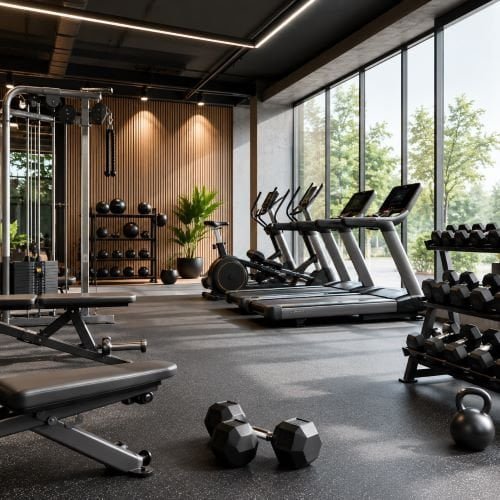
How Antimicrobial Additives Keep Sports Equipment and Gym Facilities Cleaner and Fresher?
Your gym sees sweat, moisture, and constant contact every day. Regular cleaning helps, but microbes can return quickly between cleaning cycles and affect freshness.
Antimicrobial additives can help inhibit the growth of bacteria and fungi on treated materials. When incorporated into plastics, rubbers, foams, or coatings during manufacturing, they provide an additional layer of protection between routine cleaning cycles.
A clean-looking gym creates a good first impression, but I know that surface appearance does not tell the whole story. High-touch equipment can be exposed to sweat, moisture, skin contact, and repeated use throughout the day. I believe gym hygiene should not stop at cleaning the surface. It should start with materials designed to stay cleaner.
Why Do Gym Equipment and Sports Surfaces Need More Than Regular Cleaning?
Gym operators and equipment manufacturers rely heavily on regular cleaning, yet odors and surface contamination can return quickly. The problem starts when a clean surface becomes exposed again just minutes after it has been wiped.
Regular cleaning removes dirt and microorganisms that are present at the time of cleaning, but it does not prevent new microorganisms from reaching the surface later. Sweat, humidity, frequent contact, and organic residues can create conditions that support microbial growth between cleaning cycles.
A biofilm is a community of microorganisms that attaches to a surface and produces a protective matrix. We often compare it with the slippery film that can develop on a rock in a stream. A similar process can occur on some frequently used surfaces when conditions allow microorganisms to attach and grow.
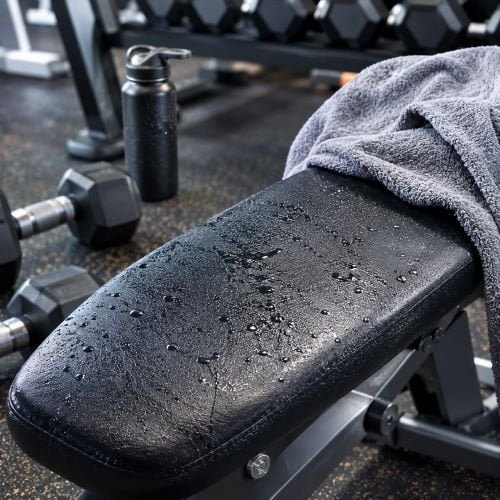
Why Can Microbial Growth Return So Quickly?
Gym equipment is a special challenge because people use the same surfaces again and again. Dumbbell grips, treadmill handles, exercise machines, lockers, benches, mats, and other components can experience hundreds of contact events during a normal day.
Moisture can add another challenge. Sweat can leave water, salts, and organic residues on a surface. High humidity can also slow drying in some areas of a fitness facility. These conditions do not automatically mean that harmful microorganisms will grow, but they can make microbial control more difficult.
I do not consider antimicrobial additives a replacement for cleaning or disinfection. Cleaning remains an important part of any gym hygiene program. I see antimicrobial materials as a second layer that works at the material level between cleaning cycles.
| Hygiene approach | Main function | Limitation |
|---|---|---|
| Regular cleaning | Removes dirt and microorganisms present at the time of cleaning | Does not prevent later recontamination |
| Disinfection | Reduces microorganisms on the surface when properly applied | Protection is generally linked to the treatment event |
| Antimicrobial material | Helps inhibit microbial growth on treated materials | Performance depends on formulation, material, and application |
| Combined approach | Supports both immediate hygiene and longer-term microbial control | Requires proper product design and maintenance |
This difference changes how we think about sports equipment design. Instead of asking only, "How can we clean this product?" we also ask, "Can the material itself help control microbial growth between cleaning cycles?"
That question becomes especially important for products that are difficult to clean frequently or that contain porous, flexible, or high-contact components.
How Do Antimicrobial Additives Help Keep Sports Equipment Cleaner for Longer?
Antimicrobial additive is a way to build an additional functional property into the material itself. The goal is not to make cleaning unnecessary. The goal is to make the material less supportive of microbial growth between routine cleaning events.
Manufacturers can incorporate antimicrobial additives into materials such as plastics, rubbers, elastomers, foams, fibers, and selected coating systems. The active components can interact with microorganisms and interfere with key cellular functions. This can make it harder for bacteria or fungi to grow and multiply on treated materials.
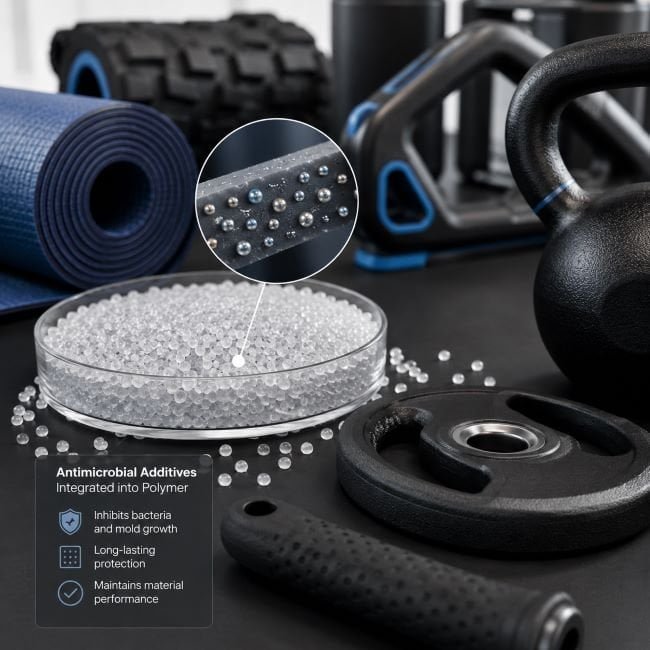
How Does an Antimicrobial Additive Work Inside a Material?
When we work with antimicrobial materials, we first look at the complete material system rather than the additive alone.
For example, a silver-based antimicrobial additive can be incorporated into a suitable polymer or other compatible material during manufacturing. Under appropriate conditions, active silver ions can interact with microbial cells at the material surface. These interactions can interfere with important cellular processes and help inhibit microbial growth.
Zinc- and copper-based technologies can also provide antimicrobial functionality, but their performance and compatibility can differ depending on the formulation and application.
We do not recommend describing any antimicrobial additive as a universal solution. The actual performance depends on factors such as the active technology, additive concentration, dispersion, polymer type, surface exposure, processing conditions, and target microorganisms.
At Langyi, we often focus on this point when discussing antimicrobial solutions with manufacturers. The right antimicrobial additive is not simply the strongest additive. It is the additive that fits the material and the final application.
What Benefits Can Antimicrobial Materials Provide?
We usually look beyond odor control when I evaluate antimicrobial materials for sports applications.
Microbial growth can contribute to unwanted odors, surface staining, and changes in appearance under certain conditions. Microbial activity can also affect some materials over time. These effects can be important for products that need to maintain their appearance and performance through repeated use.
Antimicrobial additives can therefore support several product goals:
- Odor control: Inhibiting the growth of odor-associated microorganisms can help reduce unwanted odors.
- Surface cleanliness: Reduced microbial growth can help treated materials remain cleaner between routine cleaning cycles.
- Appearance: Antimicrobial protection can help reduce some microbial-related staining or discoloration.
- Material protection: In suitable materials, controlling microbial growth can help reduce certain forms of microbial-related degradation.
- Product value: A material with an added antimicrobial function can support product differentiation in competitive sports and fitness markets.
We also think manufacturers should avoid making claims that go beyond their test data. Antimicrobial performance should be evaluated using appropriate test methods and under conditions that reflect the intended application. Standards such as ISO 22196 and JIS Z 2801 can provide useful reference methods for evaluating antibacterial activity on treated non-porous surfaces.
Choosing the Right Antimicrobial Additive for Sports Equipment and Gym Applications?
We do not believe one antimicrobial additive can meet every sports equipment requirement. A flexible yoga mat, a rubber dumbbell grip, and a rigid treadmill housing have different material and processing needs.
The right choice starts with the product rather than the additive. We first look at the base material, manufacturing process, expected use conditions, target microorganisms, required durability, appearance requirements, and applicable market requirements.
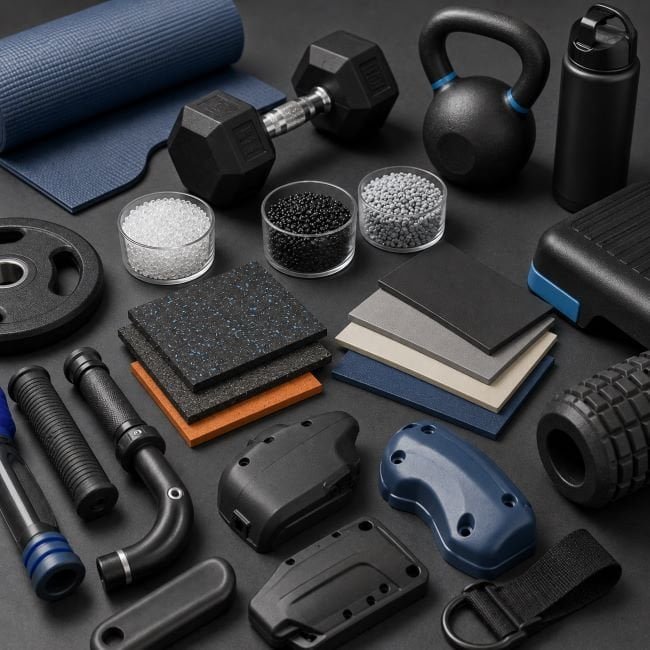
How Do We Match an Antimicrobial Additive to the Application?
When a customer comes to Langyi, we usually start by asking what the product is and how the customer plans to manufacture and use it.
A yoga mat may use rubber, TPE, PVC, or another flexible material. The material needs to withstand repeated bending and contact while maintaining its physical properties.
A treadmill housing may use ABS, PP, PC/ABS, or another engineering plastic. The antimicrobial additive needs to be compatible with the polymer and withstand the relevant processing temperature.
A gym locker or equipment panel may have different priorities. The manufacturer may care more about appearance, cost, moisture resistance, surface durability, and ease of processing.
We can therefore consider different antimicrobial technologies based on the application. Langyi provides silver-, zinc-, and copper-based antimicrobial additive solutions for different material systems and application requirements. You can explore our antimicrobial additive solutions to learn more about our product range and technical capabilities.
| Sports application | Material and performance focus | Antimicrobial solution considerations |
|---|---|---|
| Yoga mats and grips | Flexibility, durability, repeated contact | Compatibility with rubber, TPE, TPU, or other flexible materials |
| Gym flooring | Abrasion, moisture, long-term surface performance | Durable antimicrobial technology suitable for the flooring system |
| Machine housings | Polymer compatibility and processing temperature | Suitable additive form and thermal stability |
| Lockers and benches | Frequent contact, appearance, moisture | Antimicrobial performance balanced with cost and material properties |
| Sports accessories | Appearance, durability, and processing | Selection based on polymer and intended use |
Why Is Material Compatibility So Important?
Manufacturers initially focus only on antimicrobial activity. We think that approach can create problems later.
An additive may show good laboratory performance but still be unsuitable for a specific polymer or production process. Poor compatibility can affect dispersion, color, transparency, mechanical properties, processing behavior, or surface appearance.
The manufacturing process also matters. Injection molding, extrusion, compression molding, coating, and other processes can expose additives to different temperatures and shear conditions.
I therefore prefer to evaluate antimicrobial performance together with material performance. I look at the additive loading level, dispersion, processing temperature, polymer compatibility, and final product requirements as one system.
At Langyi, our role is not simply to provide an additive. Our team focuses on providing functional additive suggestions based on the customer's material and application. Dr. Tang, the founder of Langyi, is a material scientist who graduated from Tsinghua University. Our team follows the same approach by combining material knowledge with practical application needs.
This approach allows us to discuss more than the question of "Which antimicrobial additive should I buy?" We can also discuss how the additive should fit into the customer's existing material and manufacturing process.
For sports equipment manufacturers, this can be useful when developing antimicrobial plastics, rubber components, exercise accessories, gym furniture, and other high-contact products. The final goal is to create a material solution that supports hygiene, product performance, manufacturing efficiency, and market requirements at the same time.
Conclusion
I believe better gym hygiene starts before the equipment reaches the gym. Antimicrobial additives can help manufacturers design sports products that support cleaner, fresher, and more durable surfaces.